Monday, October 8, 2012

October Releases

Carole Matthews WITH LOVE AT CHRISTMAS
Little Brown
paperback
25th October 2012
£6.99

Can the imperfect family really have the perfect Christmas?
Juliet Joyce adores Christmas.  She loves the presents, the tree, the turkey, the tinsel, everything. Already the festive spirit is upon her, which is just as well as this Christmas things are starting to get out of hand. Her son Tom is out of work and bringing home a slew of unsuitable partners; pregnant daughter Chloe and her little boy have moved back in; Juliet’s father, Frank, is getting over a heartbreak of his own and Rita, her eccentric mother, is behaving more erratically each day.  And has the chaos got too much for Juliet’s husband Rick?  With the big day fast approaching, Juliet hopes that she can stop everything spiralling out of control, because the only thing she wants is her family all around her and her home to be filled… WITH LOVE AT CHRISTMAS


Phillipa Ashley MIRANDA'S MOUNT
Piatkus Entice
ebook
4th October 2012
A sexy, funny contemporary romance set in Cornwall

When Miranda finds herself fighting for her home, her job and her heart, sleeping with the enemy may not be the best tactic…
With no family of her own, Miranda Marshall has developed a healthy respect – some would say obsession – with other people’s histories. As property manager of a spectacular island castle in Cornwall, she’s made St Merryn’s Mount one of the UK’s most popular heritage attractions. While she may have the castle running like clockwork, Miranda hasn’t bargained on its sexy owner returning to claim his birthright. Dark, handsome and with a rakish reputation, Jago St Merryn not only looks like a pirate but is intent on flogging the Mount to a soulless leisure corporation. Miranda faces the battle of her life as she tries to persuade him to face up to his past and continue the St Merryn dynasty. But Jago has his own reasons for jumping ship and when he throws down the gauntlet to Miranda, she’s forced to delve into painful memories she’d much rather keep hidden…

Liz Fielding FLIRTING WITH ITALIAN
HMB Riva
Paperback/ebook
1 October
£3.49
Armed only with a photo of the house her grandfather stayed in, the village, and the name Lucia, Sarah sets out to find the woman who saved her great-grandfather's life during the war.


Christine Stovell MOVE OVER DARLING
Choc Lit
Paperback
7 October 2012
£7.99 
When is it time to stop running?  Coralie Casey doesn’t like the hand fate has dealt her so she’s taken charge of her own destiny.  Setting up ‘Sweet Cleans’, her range of natural cleaning products for body and home, she wipes away the past and starts afresh in Penmorfa, a quiet coastal village in west Wales.

Gethin Lewis thinks he’s about to escape Penmorfa for good.  Now an internationally-acclaimed artist living in New York, all he has to do is return to his home village one last time to wind up his father’s estate.

But the people of Penmorfa have other plans.  Securing a new work from a major artist could mean a big boost for the village.  And who better than Coralie to persuade Gethin to help the place that once rejected him – even if she has to go all the way to New York to seal the deal?  Yet it seems everyone in Penmorfa has something to hide; as truths are uncovered which threaten to split the community apart, Coralie also has to face the fact that some stains just won’t go away.
Nina Harrington MY GREEK ISLAND FLING
Mills & Boon
paperback and ebook
October
Could writing someone else’s life story mean re-writing her own? Sipping a cocktail under the warm Greek sun, Lexi Sloane can almost taste success. Ghost-writing a celebrity memoir on a postcard-perfect island will be the career breakthrough she’s been working towards for years…but only if she can persuade the infuriatingly guarded Mark Belmont to open up about his famous mother. Mark grew up in the spotlight and learned young to stay cautious and alert to intrusion, so Lexi has her work cut out. Lexi is hiding too – behind the experiences of those she writes about…Could she learn to be the star of her own life?
If you like the films Mamma Mia or Love Actually, you’ll love this.

Tanith Davenport I HEARD YOUR VOICE
Total-e-book
EBook
22 October 2012
£2.48 on pre-order, £2.75 after
Paranormal investigator Tamar Steele is stuck in a loveless relationship with arrogant medium Reed James - until one night she sings to herself and is knocked down by an invisible force. Somehow she can raise spirits with her voice. And one matchmaking spirit is determined to turn her life upside down.


Rena George Another Chance
My Weekly Pocket Novel
4th October, 2012
 "Rowan Fairlie, head teacher at Balcreggan Primary School, had no idea how her life would change when wealthy Clett Drummond and his two young daughters, Charlotte and Poppy, took on the tenancy of Ballinbrae Farm.
Clett insists he's come to the Highlands to help the girls recover from their mother's recent death in a car accident, but Rowan suspects there's more to it.
And why does her growing friendship with the family so infuriate the new laird, Simon Fraser?  Is his apparent hatred of Clett merely jealousy because he wants Rowan for himself, or are the two men linked by some terrible way from the past?"


Annie Burrows HIS WICKED CHRISTMAS WAGER, a short story
Harlequin
ebook
$2.39
The last person Lord Crispin Sinclair expects to see in a disreputable inn is the woman he's there to forget: Lady Caroline Fallowfield. He hasn't forgiven her for marrying another man--or forgotten their mutual passion. When she implores him to come home for his brother's Christmas nuptials, he agrees--if the now-widowed Caroline is willing to share his bed and take another gamble on love...


Ann a Jacobs THE TRADER’S DREAM #3 in The Traders series
Hodder & Stoughton, 11 October 2012
Hardback
£19.99
1869: Bram Deagan dreams of bringing his family from Ireland to join him in Australia, but a typhus epidemic in Ireland decimates the Deagan family, leaving only Maura Deagain left to look after her orphaned nieces and nephew. Forced to abandon her own ambitions, Maura sets sail, travelling via the newly opened Suez Canal. It is only when a storm throws her and fellow passenger Hugh Beaufort together that Maura realises this journey may also give her a chance to realise a dream she set aside years ago – to have a family of her own.


Angela Britnell  HUSHED WORDS
DC Thomson
Paperback
18 October 2012
£1.99
Cassie Moore and Jay Burton have a one-night stand on holiday in Italy but when fate brings them together again it's the start of a rocky ride towards lasting love. Cassie's a single mother of a troubled teenaged son and Jay has forged a successful financial career in London, far from his large Irish family. They rekindle their sizzling romance but Cassie's overwhelming family problems make a future with Jay seem nothing more than a dream. Jay's fear of commitment  and growing dissatisfaction with his extravagant lifestyle lead him to make a drastic change. When he discovers the direction he wants to take Jay finds the courage to lay it all on the line with Cassie.


Friday, September 28, 2012

Author Interview with Julia Williams

Julia Williams grew up in North London, one of eight children. She studied English at Liverpool University, where she met her husband, Dave, a dentist. They have four children and live in Surrey. A Merry Little Christmas  is her sixth book, and a follow up to her bestselling book, Last Christmas.

Welcome to the blog Julia, please do describe your journey as a writer. How did it begin?

I think I’ve always been a writer, in that, from an early age, I made up stories in my head, and acted them out. But real life interfered for a very long time, and it was only when I stopped work after my second baby was born that I finally did something about it. I was lucky enough to have a career in children’s publishing before I became a writer, and, thanks to having edited some teenage romance, I found out about the RNA. I submitted my first ever manuscript to the New Writer’s Scheme in 1999. It took me a year to write and was truly dreadful, but I had the bug by then, and with a huge amount of help from Hilary Johnson knocked it into a good enough shape to get interest from an agent. Her welcome fax telling me that she wanted to take me on came a week before my third baby was due, so my putative writing career stalled for a bit! My agent, Dorothy Lumley, was immensely patient with me, as baby no 4 popped up before I had had a chance to complete another manuscript. Eventually, when my youngest baby was a year old, I thought, I’ve got to go for it. The second manuscript was still rejected, but helpful suggestions from the editor ensured that my third was eventually published as PASTURES NEW by Avon in 2007. Since then I’ve been lucky enough to publish four more books, and my sixth, A MERRY LITTLE CHRISTMAS is coming out in October.

How would you describe your own books? And what do you enjoy most about writing them?

I try to write stories with romance, but based on reality. Write what you know, is what they say, so my stories are very family based, and deal a lot with the struggles of coping with children, and elderly parents, and keeping love alive in the middle of it all. At heart I’m an optimistic person, so I try to make them life affirming if I can.  I really enjoy getting into the hearts and minds of my characters, and certainly when I am writing, they are all real to me! I also love putting them through the mill, and have them come out the other side. And have even been known to cry when I’m writing sad scenes!

Has your childhood influenced you as a writer, if so in what way?

That’s an interesting question. I’m not sure if it has or not. Certainly, the reading I’ve done as a child has had a massive influence. I have always been a huge fantasy fan, so there are elements of magical realism in my books (and I am writing a teenage fantasy at the moment as well). I also have a keen love of history, fuelled by a teenage passion for Jean Plaidy, which is probably responsible for me writing romance in the first place.

What do you think is the most essential element of a good novel?

A gripping story and interesting characters. If I don’t care about the characters I read about , or what becomes of them, then I’m usually not interested in reading further.

Do you think writers should follow the latest hot fashion or write what they love?

I think they should do a bit of both. Keeping a weather eye on the zeitgeist is essential – there is simply no point producing work the market doesn’t want. However, that doesn’t mean you should indulge in copycat writing of the type that is going on with the Shades of Grey phenomenon at the moment. You should also write what you love too – if you don’t care about your story who else will? And despite my saying you should be aware of the zeitgeist, there’s nothing wrong with starting trends either. As my mother always  says, set the trend, don’t follow it!

Of all the characters you’ve created, which one holds a special place in your heart?

Harry, the elderly neighbour of my first heroine Amy, in Pastures New. I had been thinking about my father in law when I wrote him, but when it was finished, my sister told me I’d recreated my dad. And in part I had. A lot of Harry’s philosophy came from my father, who sadly died before I was writing. He was an English teacher and an immensely influential part of my life. So Harry makes me think of him, and I love him accordingly.

How do you relax when you’re not writing?

I’m a really busy mum of four, so when I’m not writing, I usually don’t have much time for relaxation! However, when I can, I do try to exercise as much as possible, and I find gardening a brilliant way to unwind, as it’s the one activity I can do which doesn’t involve thinking at all. Wine also helps, but not, usually, at the same time!

Which craft tip has helped you the most?

I’m not honestly sure. I came into writing after having been an editor, so I think I possibly started from a more informed base then a lot of newbie writers, and I’ve never been a huge fan of books on how to write. But the best advice I was ever given is to develop a tough skin, take the rejections and listen and learn from them. I thought I knew about writing when I started out. I was quickly disabused of that notion and feel I am still learning my craft.

What’s your favourite film adaptation of a book?

Last of the Mohicans. Which is probably cheating as I’ve never read the book, but I love the romance of the film. Would love to write something as good as that one day!

Can you tell us something of what you are working on now?

Yes. I’m working on a new book called Midsummer Magic, which is a bit of a riff on A Midsummer Night’s Dream. It involves a young couple organizing a wedding, with their best man and bridesmaid, a fading soap star, a jealous ex, and a mischievous hypnotist, causing trouble for them all on Midsummer’s Eve…

A Merry Little Christmas is published on 25 October 2012
http://www.amazon.co.uk/Merry-Little-Christmas-Julia-Williams/dp/184756089X/ref=sr_1_1?s=books&ie=UTF8&qid=1345825646&sr=1-1

An absorbing novel about family, love and friendship from the bestselling author of LAST CHRISTMAS.

With four children, a Christmas cookbook to write, and her mum suffering from dementia, Cat Tinsall has plenty to juggle. When her eldest daughter, Mel, starts going off the rails, Cat has even more on her plate. Pippa Holliday adores her family, although often finds her hands full. When Dan is involved in a terrible accident, Pippa’s world is suddenly turned upside down. Balancing her job as a school teacher with twins and her step-son Steven isn’t easy for Marianne North. With her husband’s ex causing trouble, life is getting even trickier. As Cat, Pippa and Marianne help each other through a difficult year, they’re all hoping for a much brighter Christmas.

Thank for sparing the time to talk to us today Julia, and we wish you every success with this and future books.

For more information about Julia and her books, please go to: www.juliawilliamsauthor.com.
And can be contacted on twitter @JCCWilliams

Tuesday, September 25, 2012

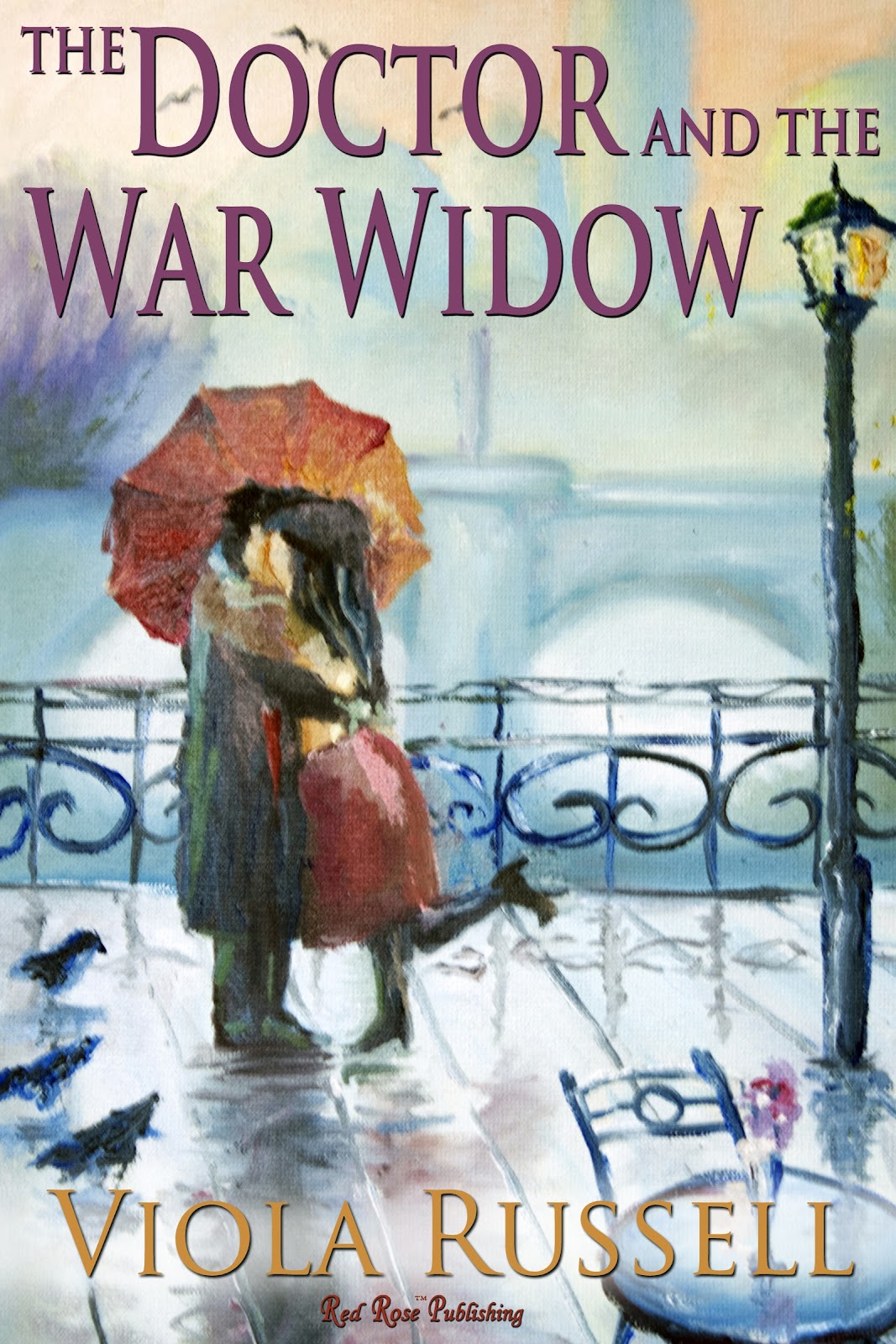
Author interview with Viola Russell

 
A warm welcome to American author, Viola Russell, whose latest book THE DOCTOR AND THE WAR WIDOW was inspired by both her travels and life experience. Viola, tell us about your latest book and how you used your travels to inspire you.

I wrote THE DOCTOR AND THE WAR WIDOW by using experience from my travels and experience.  Harley, like me, is a teacher who has suffered a great loss.  Her mother has died, and she feels that loss acutely.  She also is a widow, and though I'm not married, I understood the grief she feels.  Her husband was taken from her while he served in Iraq.  I live in New Orleans, and my beloved NOLA is as much a character as any of my "real" characters.  London and Liverpool are two of my favourite cities.  I travelled to London as a student, a visitor, and a researcher on numerous occasions, and I first came to Liverpool after my mother died.  I'd heard about Julian Lennon's White Feather Exhibit, a tribute to his father, and I understood his need to connect to his dad.  I loved Liverpool. It reminded me of New Orleans with friendly but frank people.  The city is a port, rich in history and lore.  I'm a huge Beatle fan, but even if you aren't a fan, there's lots to love in Liverpool. The whole city throbs with history, lore, and passion.  As I wrote my novel, I started to think that a proposal and marriage in that city would be wonderful.  In THE DOCTOR AND THE WAR WIDOW, my protagonist's lover proposes to her at Strawberry Field.  
 
Which character from your book would you most like to trade lives with?

I don't know that I'd like to trade places with Harley, but I admire her ability to break from the chains that bind her to the past.  She has to let go of the past--not the good memories--but the ones that threaten to cripple her.  Only then can she start a new life.  


Setting a character are equally important.  In LOVE AT WAR, England, France, and Germany are important to the story, but the plot surrounding my protagonist Nuala and her friends is what gives the setting its pulse.  Ireland also is important to PIRATE WOMAN, but it is Grainne O'Malley who gives the story its flavour.  

 How long, on average, does it take you to write a book? How much editing do you do?

I write contemporary romance, mystery, and historical fiction.  My editing techniques and writing practices vary with the genre.  Historical fiction takes a long time to write. I research a great deal before I write, and my editing is also extensive.  The contemporary romances take a shorter time to write, but I'm still an obsessive editor.  


My instinct is to write by just that--"instinct," but I know that not plotting is a mistake.  I especially have to plot carefully with historical fiction and with mysteries.  Not plotting a mystery can be disaster, and I also plot when I write historicals.  Dates and facts should be accurate.  When I wrote LOVE AT WAR, I really outlined the story's chronology and the details that surrounded certain events.  I discarded some and wove others into my plot.  In PIRATE WOMAN, I had a very real responsibility.  Graine (Grace) was a real person. I had to find fact, fiction, and lore about her.  I also had to know about the period in Irish history.  

Viola outside John Lennon's former home.

I've never followed fashion.  When I wrote LOVE AT WAR, I wanted to tell the story of my mother's generation.  An agent who is a friend told me WWII wasn't selling. I didn't care.  Writing that novel after my mother's death was cathartic.  I didn't care what anyone told me.  Writing LOVE AT WAR was one of the best thing I ever did.  In PIRATE WOMAN, I wanted to tell the story of Grainne O'Malley. Some people warned me that others had written about her.  I didn't care.  The woman intrigued me.  That was another wonderful experience and transported me to 1500s Ireland. 


I go for the red wine and cheese.  Of course, I'm a good girl.  I work out first. 

 Thank you for talking to us, Viola. We wish you every success with Doctor and the War Widow.

Best wishes Kate.

To find out more about Viola’s work visit her website at www.violarussell.com.

Friday, September 21, 2012

Interview with Elizabeth Hanbury

I’m delighted to welcome Elizabeth Hanbury to the blog today. Elizabeth says she loves to combine humour, emotion, great characters, engaging plots and historical detail in her work. She writes Regency-set novels and short stories that appeal to a wide range of readers. Her titles include The Paradise Will, Ice Angel, Midsummer Eve at Rookery End, Brief Encounters, A Bright Particular Star and The Cinderella Debutante. Elizabeth lives in a village in the heart of the English countryside and writes romance whenever she can sneak away to her desk. Does living in a typically English village in the heart of the countryside help you to write your delicious regencies?

Yes. Any small community provides a wealth of ideas for a writer. An English village may look sleepy but plenty of intrigue, absurdities, humour and dark deeds lurk just beneath the surface! Agatha Christie’s famous sleuth Miss Marple summed it up perfectly: “In an English village, you turn over a stone and have no idea what will crawl out.”

Humour is an important element of your style, what is your secret for making dialogue sparkle?

The tone of my writing is naturally light and that feeds into my characters and their dialogue. In my opinion a shared sense of humour is often at the heart of a romance. I try to write romances that are humorous and fast paced but have an undercurrent of emotion too. It’s a balancing act – darker themes can be included but they can’t overshadow the overall tone and there always has to be an emotional payoff for readers.

A secret for making dialogue sparkle? I don’t have one, but I often read scenes aloud during the final edit to check it sounds natural. Writing dialogue is the easiest part of the process for me.

Tell us about the first book you ever had published, and was it the first you ever wrote? 

My first published book was THE PARADISE WILL in 2008. It was the third full- length manuscript I’d completed but I decided to submit it to the RNA New Writers Scheme. I received some fabulous constructive feedback, edited again and sent it off to a publisher. When they wrote back and said they wanted to publish, I re-read the letter several times – I couldn’t quite believe it.

What advice would you give to an aspiring writer wishing to break into the regency romance market? 

First - persevere. It takes time to produce a manuscript ready to submit to an agent or a publisher. Don’t be tempted to skimp on effort at this stage.

Second - be willing to learn and improve. Good writers don’t spring out of nowhere fully formed; they’ve usually taken years and thousands of words to get to that point.

Third - Have faith in your characters, your story and yourself but also be prepared to judge your work with a critical eye. And develop a thick skin for the inevitable rejections.

What is it about the Regency period that so excites you, and how do you set about your research?

I love the paradoxes of the era. The Regency is associated with elegance and refinement, but it was also a time when the country was at war, an age of innovation, extravagance, vulgarity and gambling. It was a society on the cusp of reform. A huge amount of energy was packed into a relatively brief period. The tone was set by the Prince Regent himself, who despite his procession of mistresses, increasing weight and high living, possessed a terrific sense of style – something the era came to reflect.

For research I use contemporary sources such as diaries, memoirs, letters, newspapers. I also have growing library of Georgian and Regency reference books. There’s the internet too, of course, and I usually spend far too much time surfing the web uncovering fascinating Regency facts. But research in historical romance should be like an iceberg – most of it should be hidden beneath the surface and not obvious to the reader.

With the increasing popularity of ebooks, how do you think digitisation has helped or changed your own career as a writer? Have you self published anything? 

Not yet, but I probably I will in the future. The publishing industry is undergoing exciting change and everyone needs to adapt. Ebooks and increased publishing options mean more choice, more flexibility and more opportunities for readers and for writers. Print books won’t die out any time soon but ebooks and digitisation have opened up new horizons and helped me reach more readers which is what every storyteller wants. But in the end how a book is published isn’t as important as it being a good book. Good books will continue to find an audience and stand the test of time.

Of all the characters you’ve created, which one holds a special place in your heart? 

I like aspects of them all but two of my characters developed in unexpected ways so they stand out for me: Sir Seymour Dinniscombe in ICE ANGEL was sketched out at the planning stage as a rich Regency fashionista but minor character only. He went on to have a pivotal role in the plot, his own romance and appear in the sequel, A Bright Particular Star. He may appear in future books too.

Luc Grey, one of the secondary characters in A BRIGHT PARTICULAR STAR, kept pushing his way to the front when I was writing. By the time I had finished, he had become a complex, fascinating man. And I can’t say more than that because it would be spoiler.

If you could slip into a time machine and meet a famous historical figure from the past, who would you choose and why? And what would you ask him or her?

I’d like to meet Sir Isaac Newton, often described as the father of modern science. I’d ask him if the famous story of the apple was true or a myth and show him my mobile phone to see what he thought of it!

What do you enjoy most about being a writer, and the least? 

Most – the feeling you get when ideas are flowing fast and furious and your fingers are struggling to keep up Least - staring at a blank screen.

Tell us about what you are writing now? 

I’m working on a novella entitled CHRISTMAS AT RAKEHELL MANOR. Along with some surprises, in the best traditions of Christmas it will feature love, warmth, mistletoe and a wily old gentleman with a white beard!


The Cinderella Debutante, published 24th September 2012 by E-scape Press Ltd 

Lucy Sinclair’s London Season was cut short by tragedy. Now, five years later, she is returning but only in the shadow of her lovely step-sister. Belinda is determined to catch a titled husband and Alex, Lord Devlyn fits the bill perfectly. Lucy finds Alex devastatingly attractive yet knows he will be dazzled by Belinda’s beauty. It seems her one chance of love is lost forever until an unlikely fairy godmother makes Lucy the belle of the ball... 
 
Thank you Elizabeth for sparing time to talk to us today. We wish you continuing success with the books. 

Kind regards, Freda 

Find about more about Elizabeth Hanbury and her books:

Interviews on the RNA Blog are for RNA members, although we do occasionally take guests. If you are interested in an interview, please contact me: freda@fredalightfoot.co.uk


Tuesday, September 18, 2012

Guest post from Nicky Wells

I am delighted to welcome new member Nicky Wells to the blog as she celebrates publication of her first book. Born in Germany, Nicky moved to the United Kingdom in 1993, and currently lives in Lincoln with her husband and their two boys. In a previous professional life, she worked as a researcher and project manager for an international Human Resources research firm based in London and Washington, D.C. Nicky writes fun and glamorous contemporary romance that rocks the world. When she is not writing, she's a wife, mother, and occasional teaching assistant.

I shall now hand over to you, Nicky, for your guest post... Titles and covers, and covers and titles… A tale of mutual interdependence! 

Sophie's Turn is my debut novel, a glamorous contemporary fairy tale featuring a rock star and the girl next door. Sophie's Turn is the perfect title, slightly enigmatic for those who haven't read the book, but suggestive, too: of turning this way or another, of having a turn, of turning. I'm deeply in love with it.

But I have to confess, I loved my working title as well. For Sophie's Turn wasn't born thus. My working title was Full Circle. (Actually, the working title before that was Star-Struck but I abandoned that early on as misleading). So, Full Circle. To come full circle. To end up where you began, in a manner of speaking. Probably not quite in the same place. Certainly older, and wiser. And definitely for a good reason. Yes, it appeared to be a powerful title, and for the best part of six years, that was how I referred to my first masterpiece. I had even made myself a nifty little logo, a kind of dynamic circle incorporating an arrow, almost but not quite making a spiral. It graced the spine of the folder that housed my manuscript, as well as the front page, and I had always assumed I was going to make a fancy design with it for the book cover.

Ah yes, that brings me to the crux. The cover. You see, that was when it all fell apart. I was trying to come up with a concept for the cover, and I was working with rings and bracelets and champagne flutes and backstage passes… I was going all out on glitz and glamour and suggestion. However, it wasn't working. No, not at all. How very frustrating. Naturally, I spent the obligatory time agonizing over a million iterations of my cover, right down to a fancy font for my title, Full Circle. It was all- consuming and frustrating, and it was going nowhere.

It was my husband who broke my mental deadlock. “This isn't working,” he observed drily. “What are you actually trying to show here?”

“You've read the book. You know,” I snapped back (for I was in a thoroughly snappy mood by then).

“Spell it out for me again,” he persisted. So I took a deep breath and homed in on the core conundrum. “All right,” I muttered, drawing a stick figure. “Here's Sophie and she's kind of at a crossroads. Should she choose her fiancé, dependable if slightly boring Tim, or Dan, the rock star, who also wants to marry her? Which way should she turn?”

At this stage, I had added thought bubbles and love hearts to the stick figure, and it was a riot of scribbles and colours. My adorable other half, however, read this better than I, focusing on the key word. Turn. He swiftly reconfigured my scribbles into a nifty design involving a signpost at a crossroads. Brilliant. I was electrified and we got carried away building out the concept. Except… bother. The signpost was distinctly… straight, and vertical. Talk about conflicting imagery and metaphors on your cover page.

“It'll have to go,” husband concluded on my behalf, as I was still resisting the obvious conclusion. “Huh?” was my not-so-eloquent response. “The title. You need a different title.”

I bristled… and caved in a microsecond. It was apparent that he was right. So we used the new cover design for a brainstorming session and hit upon Sophie’s Turn. I think we uttered it at the same time, and it stuck. It was just so perfectly… right. I've never looked back.

Oh, but hang on, you say. What signpost? I see no signpost on your cover. It features the Eiffel Tower and a carousel. That's right! Because you're looking at the cover redesign that came a little later in the process, when I wanted to move away from my original hand-drawn cover, beautiful as it was. What's on the cover now gives you a glimpse of the story, has a more glamorous, grown-up feel, it has more panache… yet it still connects with the turning imagery, and the combo is absolutely perfect.

Intrigued?

So let me introduce Sophie's Turn to you:

Sophie's dream of marrying lead singer Dan could be within reach…if she could just figure out what to do about her engagement to Tim. 


Slapper. Slut. Adulteress. These are hardly words that Sophie Penhalligan would normally use to describe herself. Yet this is exactly how she is behaving, all things considered, even if she isn't quite married to Tim yet. And it's all happening because her past is coming to tempt her! Nine years ago, she met her teenage idol and rock star extraordinaire, Dan, up close and personal. Well, almost. Now Dan has crash-landed back in her life. How could Tim ever stand a chance against the charming, handsome singer? How could she? 

Sophie, now twenty-eight and a budding newspaper journalist, is happily embroiled in a relationship with Tim, her boyfriend of two years. Until recently, she was confident that Tim would eventually propose—probably as soon as he could get his act together. But just as Tim's persistent inaction is beginning to cast a cloud over their relationship, Dan's sudden reappearance turns Sophie's world upside down. Thus unfolds a roller-coaster of events including an ill-fated trip to Paris with Tim, a night of unfulfilled romance with Dan, Sophie and Tim's engagement party gate-crashed by Dan, and Sophie's professional secondment to accompany Dan's band on their revival tour—at Dan's special request and very much against her will. 

And then, one fine day in Paris, Sophie suddenly finds herself engaged to Dan while her erstwhile fiancé Tim is... well, doing whatever it is Tim does back in London.

Sophie's Turn is available from Sapphire Star Publishing

You can find out more about Nicky on:

Interviews on the RNA Blog are for RNA members, although we do occasionally take guests. If you are interested in an interview, please contact me: freda@fredalightfoot.co.uk
 

Friday, September 7, 2012

Interview with Liz Harris

I’m delighted to welcome Liz Harris to the blog today. Born in London, after graduating from university with a Law degree, Liz moved to California where she led a varied life, from waitressing on Sunset Strip to working as secretary for the CEO of a large Japanese trading company. Upon her return, she gained a degree in English and taught for a number of years, contributing weekly articles on education to a local newspaper. In addition to novels, short stories, and a novella published by DC Thomson, she also organises the RNA's Oxford Chapter, and is on the committee of the HNS Conference 2012. 

I see that your new novel takes place in the 1950s and in 1995, set partly in London and in Ladakh, a country north of the Himalayas and west of Tibet. I’d love to hear how you were inspired to choose such an unusual setting. 

Three years ago, my cousin, who now lives in Australia, asked me to help her to find a home for an album that her father, my late uncle, had compiled after a visit he made to Ladakh in the mid 1940s during the time he’d been stationed with the army in North India. His album is now in the Indian Room of the British Library, on Euston Road. When I read it, I fell in love with Ladakh, and knew that I had to set a novel there. At that point, I began to research the country in depth.


The novel has been described as ‘a sumptuous tale of love and adventure … which throws together two people from radically different cultures with explosive results.’ Tell us more about how you devised your hero and heroine. 

From the outset, I knew that my heroine, Patricia, was born in the 1950s and brought up in Belsize Park, a part of London I know well. I saw her as a lonely child, living with parents who’d been torn apart by grief over a tragedy that had happened to the family in the past. I didn’t yet know anything about my hero, Kalden, beyond the fact that he was born and brought up in a Ladakhi village in the Buddhist part of the country. Whilst I waited to ’see’ him clearly, I continued to learn about the country. And then one day, I read a very interesting fact about life in Ladakh. From that moment on, I could ‘see’ Kalden and I had my story.

The research must have created particularly challenging problems. How did you set about it? 

Ironically, it was considerably easier to research THE ROAD BACK than the novel I’m writing at present, which is set in Wyoming in 1887. Having a very low blood pressure, visiting a country of the altitude of Ladakh was never a possibility, so my uncle’s album was the starting point for my research. After that, I had to rely upon my computer, and on the books I could find. They proved to be rich sources of information and through them I became familiar with Ladakh’s geography and traditions. By the time I started to write the novel, I was able to see Ladakh in my head as if I had been there. Happily, Wyoming is at a lower altitude than Ladakh, and my husband and I went there this summer for a combination of research and holiday. Guess whose idea the location was?

Have you always wanted to be a writer or did it come about by chance? Tell us about the thrill of getting that first call. 

It was many years before I thought about trying to make money from writing, although I’ve loved writing for as long as I can remember. I loved writing essays and stories at school and at home, and even enjoyed writing the essays for both of my degrees. My career choices changed over the years. First I wanted to be a farm hand, then a journalist, teacher, and a nun. The desire to be a nun lasted for ages as the memory of rugged Peter Finch as Dr. Fortunati in The Nun’s Story lingered long in my mind.

However, one night when my young sons were in bed – yes, I’d ditched my plan to become a nun - and my husband was out, I found myself staring at my typewriter. I suddenly pulled it towards me, checked that I had a packet of tippex paper to hand, and started to type. At that moment, I found my vocation, and I’ve never looked back.

When did you hear about the RNA, and how has it benefited your career? 

The RNA has helped me in so many different ways: teaching me about the publishing industry, thus equipping me better for my attempts to become a part of it; the NWS critiques which offered invaluable advice; the workshops, in and out of the conference, which gave me a chance to learn new skills and hone older ones, and above all, being part of such a warm, friendly community, which is unfailingly generous in its support to everyone, published and unpublished alike. Writing may be a solitary occupation, but when you’re part of a community like the RNA, it isn’t a lonely one.

Can you work anywhere, or do you have a favourite place to hideaway and write? 

I can work anywhere – on the Oxford Tube, in a bus, Starbucks, a library - but the place I like to work in most of all is in my study. It’s my little piece of paradise, although it’s all too often an untidy paradise. Which did you find the hardest part of the novel to write, and how did you overcome any problems? I can’t point to a specific area that was difficult to write – at all times I knew where I was going. But as a general point, I had to be continually aware that whilst I found the culture of Buddhist Ladakh absolutely fascinating, and whilst I’d fallen in love with the dramatic beauty of the country, I must never allow either to come between the reader and the story of Patricia and Kalden. It’s their love story that lies at the heart of the novel.

Have you ever suffered rejections, and if so, what made this book a success?

I’ve definitely had my share of rejection letters. I think a combination of things helped me to be successful with THE ROAD BACK. I’d written for seven years, had each of my novels critiqued and then carefully edited the novel, thereby improving my writing. The background of the novel is original - just as I hadn’t heard of Ladakh until three years ago, most of the people I meet haven’t heard of it. It’s interesting (I hope!) to read a novel set in a place that’s different from familiar locations. And then there’s luck. Luck is tremendously important. I was so very, very lucky that my manuscript arrived on the right desk at the right time.

How do you relax when you’re not writing? 

I read a lot. I can’t imagine any writer who doesn’t read a great deal. Apart from the sheer pleasure of being transported into the world of the fiction, it’s a great learning tool. In addition, those who follow me on twitter know that I regularly go to the London theatre. Being the daughter of an actress, I was given a love of the theatre at an early age, and one of my greatest thrills is the moment before the lights are lowered and you wait for the start of the story that’s about to unfold before your eyes. I also love cryptic crosswords, especially the Daily Telegraph cryptic.

So what next? Where do you go from here? Will it be another unusual setting?

Wyoming, 1887. I should really say ‘Wyoming Territory’ because Wyoming wasn’t admitted into the union until 1890, when it became the 44th state of the USA. My husband and I went to Wyoming in August. We stayed first on a working ranch just north of the Colorado border, set amid stunning scenery, and there I was able to put to the ranch owners and wranglers the many questions that my research hadn’t been able to answer. Surprisingly little is known about second generation homesteaders in the late 1880s. We then drove to Cheyenne, Lander, Yellowstone, Jackson Hole, Cody and back to Cheyenne. The museums I visited on the way, and the local people I met, supplied the rest of the answers I needed.


When Patricia accompanies her father, Major George Carstairs, on a trip to Ladakh, north of the Himalayas, in the early 1960s, she sees it as a chance to finally win his love. What she could never have foreseen is meeting Kalden - a local man destined by circumstances beyond his control to be a monk, but fated to be the love of her life. Despite her father's fury, the lovers are determined to be together, but can their forbidden love survive? A wonderful story about a passion that crosses cultures, a love that endures for a lifetime, and the hope that can only come from revisiting the past. 

Thank you Liz for sparing the time to talk to us today. We wish you continuing success in your career.

Kind regards, 
Freda 

To find out more about Liz visit her website: http://www.lizharrisauthor.com/ 

Interviews on the RNA Blog are for RNA members, although we do occasionally take guests. If you are interested in an interview, please contact me: freda@fredalightfoot.co.uk 

Tuesday, September 4, 2012

Interview with Jenny Barden

Jenny Barden is an artist-turned-lawyer-turned-writer who I am delighted to welcome to the blog today. She claims to have had a love of history and adventure ever since an encounter in infancy with a suit of armour at Tamworth Castle. Jenny has four children and lives in Hertfordshire with her long suffering husband, a loving Labrador and a deadly Bengal cat. 

I believe Mistress of the Sea is your first novel. Do tell us what inspired you to write it.


Travels in South and Central America led me to Francis Drake and his little known first great enterprise: the attack on the Spanish 'Silver Train' in Panama. This episode was so fascinating I thought it would make a terrific backdrop for a novel. It has all the classic ingredients for a great adventure: an exotic setting, a leader who rose from obscurity to achieve great fame. To my mind, the one ingredient this true story lacked to make it utterly compelling was a love interest, and I provided that by introducing my fictional characters, and in particular my heroine, Ellyn. It was great fun imagining how this episode might have played out had a woman been involved.

What is it about historical fiction, and this period in particular which grips you?

I love historical fiction because it doesn't date. This might sound strange, but consider the constraints upon those who write contemporary fiction. They must always be bang up to the minute with the latest fashions, idioms, technology and trends - almost anticipating what will happen because when their work is eventually published, probably a year or more after it's actually written, it has to seem just right to the readers of the future, happening in the 'here and now' and relevant to what's going on; that's very hard in a world that's changing ever faster. There are no such difficulties with historical fiction. The history provides a wonderful framework upon which to hang stories that have the potential to be timeless.

What particularly attracts me to the Elizabethan period is that it was our Renaissance, the time when England began to become a significant player on the world stage, one which saw a flowering of art and culture: the age of Shakespeare and Bacon, Raleigh and Hilliard.

Do you research before you start, as you write, or both?

The relationship between research and storytelling in my work is symbiotic. A huge amount of research comes first - I would not dream of writing a story and then trying to tack that back into the past retrospectively. For me, the story evolves from a consideration of what actually happened, but then writing the story helps me better understand the research!

Before I begin writing, I like to read all the key texts, do as much investigation on the ground as I can, plan carefully, and draw up a detailed outline in which the relevant history is summarised alongside my ideas for the story. But as I write I invariably find that more research is needed of a more detailed nature and that will usually send me back to the texts again - or on another journey!

My bookshelves are full of reference material for this purpose, some of it quite obscure. (An example is: Ships' Bilge Pumps - A History of their Development, 1500-1900 - I shouldn't think that appears in many bookcases!)

Is this fiction based on fact? Are there any real historical figures in your story and if so, did this create any problems?

My fiction is based on fact featuring real historical characters, but I made the decision early on that my central characters would be invented to give me greater freedom to tell a good story rather then limit myself to retelling the history. Francis Drake is a key character in Mistress of the Sea, but the core romantic adventure does not revolve around him. I've been careful to be true to Drake, the man, as I found him in the contemporary accounts, often using his actual words in dialogue. But I've also had the luxury of being able to tell the story of Will and Ellyn without having my hands tied.

It's good to see not everyone works in an office. Do you have a critique partner, or share your work with anyone before you submit to an editor or agent? 

I had two good critique partners (male and female) who helped me hugely in getting MISTRESS OF THE SEA to a presentable state before submission to my agent. I've also had the benefit of an excellent writers’ circle - Verulam Writers. I was also very fortunate in getting two incisive reports under the NWS and, while Mistress of the Sea never made it to a second read, I did have the benefit of these critiques and I was very careful to take on board the points made.

I love this picture of you signing books on board The Golden Hinde. I also know that you are very involved with the Historical Novel Society, can you tell us something of that? 

The HNS is a wonderfully helpful global organisation, with around 1000 members, that exists for all those who love historical fiction, both writers and readers. And it has an open door policy, being completely non-selective. My involvement came about due to my co-ordination of the Get Writing conferences for Verulam Writers and, having seen my work there, Richard Lee, founder and chairman of the HNS, asked whether I'd help co-ordinate the next UK HNS conference. Together with the team of sixteen (amongst whom are many RNA members) I've helped set up HNS London 2012. The conference will be held over the weekend of 28-30 September in Regent Street, London, and will feature some of the leading names in HF internationally (including Philippa Gregory, Lindsey Davis, Bernard Cornwell, Margaret George, Elizabeth Chadwick and CW Gortner amongst many other great authors and industry leaders). There are already over 270 booked to attend so the conference looks set to be a stomping success!
http://www.hns-conference.org.uk/ 

Are you inspired by music when creating your fictional world?

Music is very important to me but, alas, I find I cannot write with music playing (though, oddly enough, I can paint while listening to music and find it almost essential to that process). So I listen to music while I'm doing other things and thinking about my writing - typically driving, gardening or just doing the housework - and while I'm listening I can really get myself into the mood of a particular scene. Sometimes the music is in period (Tallis and Dowland are favourites) but quite often it will only be indirectly related.

What event in history would you most like to have witnessed in person? 


Being with Francis Drake, on the Golden Hinde, when he returned to England after his circumnavigation of the globe. I would love to have been amongst the privileged few at that time to sail right around the world. Not only did Drake and his crew know that they'd achieved something truly remarkable, but they had a ship stuffed full of treasure to boot. They were made men both in fame and fortune, and they would have seen things that no one else had before and few would ever see again (sounds like rich material for another book!).

So what next? Can you tell us a little about your work in progress?

My next novel is about the first English attempt to found a permanent settlement in the New World, one involving women and children that had the potential to be self-perpetuating. It's another fabulous true story around which I'm weaving a fictional romantic adventure.


Plymouth 1570
Ellyn Cooksley fears for her elderly father's health when he declares his intention to sail with Drake on an expedition he has been backing. Already yearning for escape from the loveless marriage planned for her, Ellyn boards the expedition ship as a stowaway. Also aboard the Swan is Will Doonan, Ellyn's charming but socially inferior neighbour. Will has courted Ellyn playfully without any real hope of winning her, but when she is discovered aboard ship, dressed in the garb of a cabin boy, he is furious. 

To Will's mind, Drake's secret plot to attack the Spanish bullion supply in the New World is a means to the kind of wealth with which he might win a girl like Ellyn, but first and foremost it is an opportunity to avenge his brother Kit, taken hostage and likely tortured to death by the Spanish. For the sake of the mission he supports Drake's plan to abandon Ellyn and her father on an island in the Caribbean until their mission is completed. But will love prove more important than revenge or gold? Published by Ebury Press, Random House, and released in hardback on 30 August 2012 with the paperback to follow.

Thank you for sparing the time to talk to us today, Jenny, and we wish you every success with the book. 

Best wishes, 
Freda 

To find out more about Jenny and her books visit her website : http://www.jennybarden.com 
Twitter @jennywilldoit 

Interviews on the RNA Blog are for RNA members, although we do occasionally take guests. If you are interested in an interview, please contact me: freda@fredalightfoot.co.uk