Showing posts with label Waterloo. Show all posts

Tuesday, July 7, 2015

Louise Allen: From Fact to Fiction and Back Again

A truly fascinating account of what research can lead to from today’s guest, Louise Allen

I write historical romance, mainly Georgian-set, so I have every excuse for lots of fascinating (and work-postponing) research. My desk is heaped with books and original prints and my PC bulges with files of references and the big problem is knowing when to say “Stop!” and start getting on with the book.

A few years ago I had a light-bulb moment and realised that I could use the research I was doing for my novels and turn it into non-fiction, covering themes that interested me and which I hoped would also interest my readers. That led me to producing a book of Walks Through Regency London, which in turn led to Walking Jane Austen’s London (Shire) and a regular blog, also about Jane Austen’s London.

That, I thought, would be that, until I found myself wrestling with stagecoach timetables and Georgian road maps and lists of inns as I tried to plot my heroine’s journey as she first of all eloped, and then fled from her lover, in From Ruin to Riches. What I could not find was a book about the experience of stage and mail coach travel for the passengers – so I wrote one, Stagecoach Travel (Shire). Both experiences – the London walks and the stagecoach research – led me to even more fiction plots and a real feeling of closeness with my characters as I clambered in and out of stagecoaches, or had a conversation with a gas-lamplighter in an atmospheric alleyway in St James’s. (Yes, there really are lamplighters left in modern London.)

Researching stagecoach travel made me wonder how much of the most famous of the coaching routes, the Great North Road, can still be found, so my husband and I set out to travel it and found the inns and the old bridges, the spots where highwaymen were hanged and terrible coach accidents happened – and a deserted graveyard with the headstone of a man killed in a duel with his close friend. Once more my notebooks filled up with plot and character ideas and I felt more and more in touch with the travellers of the time.

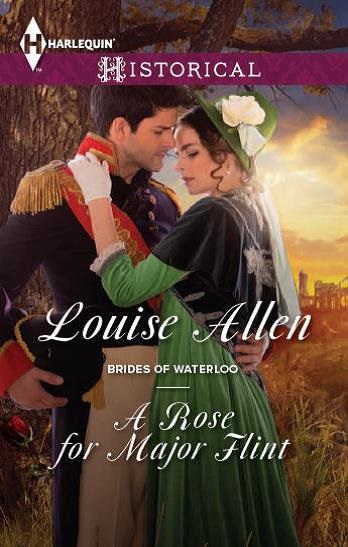
My latest book is the third in a Waterloo trilogy (The Brides of Waterloo, with Sarah Mallory and Annie Burrows.) My novel, A Rose For Major Flint, begins on the morning after the battle when my hero, Adam Flint, rescues my heroine, a traumatised, speechless young woman he calls simply, Rose, from a group of scavengers.

So, of course, I needed to know what it was like on the battlefield that morning. To my amazement I discovered that there were tourists on the field almost at first light, interrupting Captain Mercer and his artillery troop as they ate their breakfast amidst the carnage.

Soon I was accumulating first-hand accounts by travellers who, in some cases, arrived on the scene within days. From their words I knew what the battlefield looked like and smelled like and what the ground was like underfoot. I discovered what the state of the roads was and what was happening to the dead and injured and discovered tiny, heartbreaking details, such as the patches of wildflowers left amidst the carnage. I read about the gardener at Chateau Hougoumont who stayed throughout the battle and was found wandering through his wrecked gardens, bewailing the bodies amongst his cabbages, the farmer’s wife who was annoyed at the field hospital set up in her barns, but was quite pleased to have had a general nursed in her cowshed and the local peasants searching for items they could sell to the tourists – the beginning of a local industry that endures to this day. From that research came The Road to Waterloo: the first battlefield tourists 1815-1816.

A Rose For Major Flint                                                                                   To the Field of Waterloo


It is definitely a virtuous circle – my novels demand research, then the research gives me the facts, and more importantly the feel of what I am investigating, and from that I can produce non-fiction books that I hope add something deeper to my readers’ experience.

                                                                                   
Louise Allen’s 50th historical romance for Harlequin Mills & Boon comes out this year and she is also the author of five historical non-fiction titles. She lives on the North Norfolk coast with her husband and a garden full of bossy pheasants and travels as much as possible in search of inspiration and to escape deadlines.

@LouiseRegency

Louise, you will have touched many of us today with your references to Jane Austen, Regency London, Georgian road maps and Waterloo. It would seem your knowledge is encyclopaedic. Cue for another book?

The RNA Blog is brought to you by 
 
Elaine Everest & Natalie Kleinman

If you would like to write for the blog please contact us on elaineeverest@aol.com


Tuesday, April 14, 2015

Writing a trilogy: The Brides of Waterloo


Welcome to Louise Allen, Annie Burrows and Sarah Mallory who produced Harlequin's trilogy of historical romances, The Brides of Waterloo.

Sarah Mallory writes -


Sarah Mallory

In the summer of 2012 Louise Allen, Annie Burrows and I put our heads together and came up with a trilogy of romances set around Waterloo. The premise was that our heroes were battle-hardened soldiers and we needed a regiment for them, so we decided to try something a little different. We moved away from the glamour of the cavalry or rifle regiments and settled for an artillery unit, a troop called Randall's Rogues, a bunch of misfits who just happened to be excellent artillerymen. They had been given a last chance to redeem themselves and had been brought together into a crack unit under the command of their no-nonsense Colonel, Lord Randall. As Annie puts it, "A dirty dozen in breeches"!
Once Annie, Louise and I had put together our initial proposal, and mapped out three stories, we were ready to approach Harlequin.  The RNA conference was at Penrith that year and Louise and I met up with Harlequin's Senior Editor for the Historical line, Linda Fildew, to pitch our idea in person.  Linda was enthusiastic, took it away to think about it and later that year it was accepted with plenty of time for us to write the books and for Harlequin to plan it into their 2015 schedules.
Then the hard work began, we actually had to write the books.  This involved lots of collaboration, mainly by email (thank goodness for the internet), although Annie and I did meet up in Waterstones, Manchester, where we re-enacted our battle scenes using the cruet set plus any available napkins and a sugar bowl!

Annie Burrows
Louise drew up a spreadsheet for the characters and timelines for the three books, Annie kept a note of the Dramatis Personae and I, well I just wrote!  We managed to schedule our work so that we were all writing our books at more or less the same time, which meant we could swap notes and ideas while the stories were fresh in our heads.

I bagged Randall as my hero and had the honour of writing the first book in the trilogy while Melanie and Annie chose two rakish majors, hard-as-iron Adam Flint and the unscrupulous seducer Tom Bartlett respectively.   Fortunately in Brussels at the same time are three strong and resourceful women who prove themselves to be more than a match for our Rogues!

We decided the Rogues should be in blue uniforms, like Mercer's Battery, the artillery troop that inspired our story, and Annie also came up with a motto (Semper Laurifer, which means Always Victorious).  My heroine, Mary, who finds herself at loggerheads with Lord Randall, translates it as Never Fails – To Infuriate! We also gave the Rogues a regimental mascot, a large and very hairy stray that attached itself to the unit and was tamed by Louise's hero, Major Flint. The breed we chose is known as a Bouvier de Flandres, large dogs weighing up to 120 pounds, and looking very fierce, though actually they are very gentle. Ben, or Dog (you'll have to read our books to find out how he came by his names!) features in all 3 of our stories, playing a particularly important role in Annie's  book, A Mistress for Major Bartlett.


Louise Allan


There was a certainly amount of crossover with the timelines. A Lady for Lord Randall starts some time before Waterloo and continues after the battle, whereas Annie's book and Louise's A Rose for Major Flint actually commence once the battle has ended.  We therefore have each other's characters wandering in and out of our stories. That was a challenge, but great fun, too.

It is important, when collaborating on linked books, to have confidence in your fellow authors, to trust their judgement. Louise and Annie had already collaborated on an earlier series for Harlequin, and I had known both authors for years, so we were pretty confident we could work together.  We all threw in ideas and were not afraid to speak up if we disagreed (which happened very rarely).  When we needed to use each other's characters in a scene we shared that segment, to make sure we were in agreement and towards the end of the process we read each other's manuscripts to make sure the stories and characters did not clash. Our characters were created and they evolved, squabbled, laughed, cried and fell in love against the backdrop of Waterloo in 1815. Their authors worked, sweated and laughed a lot in the process.

We are all extremely pleased with our trilogy and we hope the readers will enjoy reading these three books as much as we enjoyed writing them.

Sarah Mallory - A LADY FOR LORD RANDALL – pub Harlequin May 2015
Annie Burrows - A MISTRESS FOR MAJOR BARTLETT – pub Harlequin June 2015

Louise Allen – A ROSE FOR MAJOR FLINT – pub Harlequin July 2015

Louise Allen is working on her 49th historical romance for Harlequin Mills & Boon and her 44th, Scandal’s Virgin, won the RoNA Rose Award 2015. She focuses on the late Georgian/Regency period and also writes historical non-fiction. To the Field of Waterloo: the first battlefield tourists, will be out on Kindle shortly.


Annie Burrows has been writing light-hearted Regency romances for Mills & Boon since 2007. Her first book, His Cinderella Bride was the top seller in the historical line that year. Subsequent books have gone on to win the coveted Reviewer's Choice award from Cataromance. Her books have charmed readers worldwide, having been translated into 19 different languages

Sarah Mallory has written over 20 historical romantic adventures for Harlequin Mills & Boon and won the RoNA Rose Award in 2012 and 2013 for two of her titles. She also writes as Melinda Hammond, and her latest time-slip short story And the Stars Shine Down is now available on Kindle.
Authors' photos – courtesy of Harlequin Mills & Boon.

Thank you, ladies for this most interesting post and good luck with your publications.

The RNA blog is brought to you by,

Elaine Everest & Natalie Kleinman

If you would like to write a piece for the blog please contact us on elaineeverest@aool.com