Showing posts with label Jane Austen. Show all posts

Wednesday, September 13, 2017

Ask the Industry Expert: Literary Agent Sara Keane

Today we're delighted to welcome literary agent Sara Keane, of the Keane Kataria Literary Agency. Sara has more than 25 years' experience in the publishing industry, in roles including editorial and rights in book, video, audiobook and magazine publishing. Sara is kindly giving up her time today to talk with Helena Fairfax.

Welcome, Sara!

Please tell us a little about the Keane Kataria Literary Agency, how long it’s been established, and how you became involved in setting it up.
Keane Kataria Literary Agency is a small, boutique agency based in Bath, specialising mainly in women’s fiction, historical fiction and crime, and was founded by myself and Kiran Kataria in 2014. We decided to pool our combined 50+ years of editorial and rights experience and set up our agency after the publisher where we both worked as commissioning editors suddenly went bust. We have a growing portfolio of authors, both debut and established, with whom we work very closely on developing their manuscripts before submitting their work to publishers. Our agency is now going from strength to strength, and we have had particular success with commercial women’s fiction, negotiating multi-book deals with UK and international publishers for our authors.

What is it you are looking for when a manuscript lands on your desk? Are there any specific plots or themes you’d like to see?
As a literary agent, I am obviously looking for manuscripts I can sell to publishers, which means I very much have the requirements of commissioning editors in mind. The most important consideration is whether I absolutely love a manuscript and really believe in it, as whenever I submit a manuscript to a publisher I am putting my own reputation on the line. So it is the combination of a strong commercial hook, quality writing and my personal response as I read that makes a manuscript stand out. Specifically, commercial women’s fiction, sagas, dual narrative, psychological thrillers and contemporary crime are what we are looking for at present.

Do you ever find authors outside the slush pile? If so, how?
The slush pile is fundamental and we do find many of our authors that way, but I have also been fortunate enough to find some fantastic authors outside the slush pile. Some through personal recommendation, others we meet at publishing events. Possibly the most unexpected was when I was put in touch with an author by a lady I got chatting to in the changing rooms at my health club. That’s what’s so great about being an agent: you never know exactly when and how the next wonderful author is going to magically appear in your life.

What advice would you give someone submitting to you?
Spend a long time editing your manuscript and be ruthless! Get feedback from other writers, or even from a professional editor. Submissions from authors who have received mentoring on the RNA New Writers’ Scheme would really stand out. Know the market you are writing for and where your book would fit into that market. Please read and follow our submission guidelines (on our website) and don’t submit genres we specifically say we do not work with.

Are you seeing any particular trends in commercial women's fiction/romance at the moment?
We’ve been seeing a shift away from billionaires and bondage, and in these troubling times readers are turning to sagas and feel-good commercial women’s fiction, with escapist, aspirational settings like tea shops in Cornwall. Seasonal books are a big trend, with the emphasis on summer and Christmas. I also think we are seeing more novels about romance in later life: we’ve recently sold one about a woman in her seventies starting over. I’ve heard this referred to as ‘Gran Lit’, but I prefer to call it ‘the Judi Dench effect’.

What’s your favourite romance novel of all time?
No marks for originality, but my favourite of all time would have to be Pride and Prejudice. I first read it in my early teens (well before the Colin Firth/wet shirt BBC adaptation), and it has been my comfort read ever since. And where would romantic fiction be without P&P? Here in Bath we have just had the annual Jane Austen festival, which attracts Austen devotees from all over the world who parade around the city in gorgeous Regency costumes. I’m planning on dressing up myself next year.

Apart from your own authors, which book have you enjoyed the most in the past twelve months, and why?
I re-read The Handmaid’s Tale by Margaret Atwood after the TV serialisation, and got so much more out of it than when I first read it. It seems more relevant than ever, and reminded me that women in many parts of the world are still victims of misogyny and biological determinism - and there is no guarantee that our own society will never experience a backlash against feminism and the freedoms women take for granted in a modern liberal secular democracy. One of those freedoms being reading and writing romantic fiction, of course.

What do you like to do in your spare time?
I enjoy amateur dramatics, and usually perform in two or three productions a year. It’s fun, challenging and learning lines is very good for the brain. I also enjoy swimming, walking, gardening, upcycling furniture and visiting my family who are dotted around the world. Plus, I’ve recently started learning Italian.

If you could describe your working-day in just three words, what would they be?

Reading, editing, negotiating.

Thank you so much for taking the time to drop in, Sara, and for your thoughtful answers. It's been fascinating and a pleasure getting to know you.

If you've enjoyed Sara's interview, or have any questions or comments at all, please let us know. We'd love to hear from you!

About Helena

Helena Fairfax is a romance author and editor. Her latest release is a feel good romance called Felicity at the Cross Hotel, set in a hotel in the Lake District (the type of the escapist, aspirational setting Sara mentions!) You can find out more about Helena's books and her editing services on her website www.helenafairfax.com

If you would like to write for the RNA blog please contact us on elaineeverest@aol.com

Friday, March 31, 2017

Festivals and Workshops: Chipping Campden Literary Festival

This month Elaine Roberts takes us to the Chipping Campden Literary Festival to chat to organiser Vicky Bennett about the event and what goes on behind the scenes to prepare for the festival.

Welcome to the RNA blog, Vicky. Can you tell us something about your festival, how it came about and how long its been running?

The inspiration for running a literature festival in Chipping Campden came from the now

internationally acclaimed Chipping Campden Music Festival founded in 2002 by Charlie Bennett. In 2009 I decided to run a six-day literature festival immediately prior to the 2010 music festival. At that time there was a small bookshop in Chipping Campden. I approached Mary Gray, who ran it for the owner, and asked if she would help me run a festival. Mary sourced the initial sponsorship. We approached authors either directly or via their publishers. The initial intention was to concentrate on fiction. Key to attracting good writers was to secure one well-known author from the outset. In 2010 our first speaker was William Boyd, followed by Patrick Gale, Amanda Craig, Michael Arditti, Samantha Harvey and Adam Foulds. So, between us Mary and I had put together a programme of novelists, gathered a group of helpers to distribute programmes, and hired venues around the town. The bookshop closed two years later. The Festival bookshop is now Borzoi Bookshop Stow on the Wold, and the Literature and Music Festival now have a designated shared office, and tickets may be purchased on line. The Literature Festival offers a fee to all authors and interviewers, and for the big venue, capacity 300+, hires a sound production company. The Festival has no public funding and relies on ticket sales, local business sponsorship, and small private donations. It is therefore imperative that we engage speakers that have a wide appeal, and audiences return year on year.

Who are your main speakers this year?
Max Hastings event
As soon as one festival ends I begin to think about the next. I try to choose a writer who will set a theme for the festival. Sometimes, as this year, a festival-goer will suggest an author. Early 2016 it was suggested that I read East West Street by Philippe Sands for 2017. As I was thinking of Crime/Justice and Forgiveness as being themes for 2017 I read the book with interest, and asked Philippe Sands to be my first evening speaker, and he accepted. He has since won the Gifford Baillie prize for non-fiction.
  I soon realised at the 2010 festival that to attract big audiences, a speaker must either have written on a subject of interest to a wide audience such as world war, historic buildings, great politicians, Shakespeare, Dickens, Jane Austen or be a novelist who has become a household name through television and film. So for 2017 my other main speakers are
Non-fiction: Adrian Tinniswood The Long weekend, Lord David Owen Cabinet’s Finest Hour, Richard Holloway A Little History of Religion, Annie Gray The Greedy Queen, Kathryn Harkup A is for Arsnic: The Poisons of Agatha Christie
Fiction: Sophie Hannah Closed Casket, Mark Billingham Die of Shame, M C Beaton Pushing Up The Daisies: Agatha Raisin. At the two latter events BBC Crimewatch broadcaster Sue Cook will be in the chair.
We also have events on Dostoyevsky Crime and Punishment, Oscar Wilde, and Hamlet. At the two latter events we have well known Archers actor Timothy Watson (Rob Titchener) reading.

As our blog is for writers can you tell me how your festival would benefit our members?
Reading, meeting and listening to good authors speaking about their own work or hearing academics
talking about great writers is essential to being a good author. Additionally, Jane Corrie (whose first psychological thriller My Husband’s Wife was a 2016 Sunday Times best seller) is in 2017 running a day workshop: Expert practical advice on how to find the right idea, create characters, write realistic dialogue, get to grips with viewpoint, put the reader in the setting, and get published.
We also spread the word about other festivals and author events via twitter. Following us, and other festivals, is a good way of finding out what is happening at festivals, what is being published, and what is being reviewed. If an author emails me about appearing I always respond even if I can’t offer a space. It is essential for an author to approach me as soon as one festival is finished in order to be included in the next programme. But not to send a book until requested because it will only be read if the intention is to include it.

How about staying over for the whole event. Where can people stay? 
Chipping Campden, a bustling Cotswold market town in an area of Outstanding National Beauty, is geared up to visitors. 
There is an exceptional amount of accommodation from private B&B's to atmospheric pubs and a four-star hotel plus masses of self catering cottages. There is also a range of places to eat out, and high quality food and wine to take away for self-caterers.


What does it cost to attend?
The Printers Wayzgoose is free, film £5, poetry reading £4, main talks £7, Lunch event £29. All evening and weekend talks are free to full time students.

Do workshops/talks fill up quickly?
Some of our daytime venues are small so these talks can fill quickly. Also numbers at workshops limited. Friends of the Festival get priority booking:
Minimum donation of £25
Please make cheques payable to
‘Chipping Campden Literature Festival’ And post them to:
Vicky Bennett, Literature Festival, The Old Police Station, High Street, Chipping Campden, GL55 6HB


How much time does it take to organise the festival?
Full time for each year: as one festival ends so the next begins.

Dates for the next two years:
Tuesday 9th- Sunday14th May 2017 inclusive 
Dates for 2018 TBC

Link to the Chipping Campden Festival website

Email for queries: Vicky Bennett vicky@campdenlitfest.co.uk

Thank you, Elaine. This is certainly a literary festival worth visiting.


Tuesday, October 6, 2015

Ticking All the Boxes


Today we welcome Fenella Miller to the blog. Fenella tells us how she and four other authors collaborated to produce box sets.

I would like to say thank you for inviting us to be part of the RNA blog. Melinda Hammond, Amanda Grange, Elizabeth Bailey, Monica Fairview and I are all bestselling authors in a variety of genre. I discovered a multi-author crime box set and thought it an excellent idea to promote each other’s work and get new readers.
Regency Quintet
Christmas Edition

Our first foray into multi-author box sets, the Valentine Edition, had a slightly different format as Wendy Soliman was one of the five authors, but she had to drop out and we were delighted Monica Fairview was able to join us. This box set did amazingly well – way above our expectations so we decided to continue. The second, Regency Quintet Summer Edition, also did well. We are just about to publish our Christmas box set and this is the first one with new titles.

This has been an enjoyable venture. However, as the box sets are on my account I have to keep track of sales and work out the royalties, which is a worry. If you have friends who write in a similar genre you could do this. Our box sets sell at £1.99 – an absolute bargain for five books – so don’t expect to make a fortune - think of it as a promotional opportunity. You might be lucky and find your box set becomes a bestseller. My advice is to have a go – but whoever’s hosting shouldn’t have more than two to juggle with.

A Most Unusual Christmas
Fenella J Miller
Miss Cressida Hadley is delighted when Lord Bromley and his family are unexpectedly obliged to spend Christmas at The Abbey. However, falling in love with Lord Bromley hadn’t been part of her plan.

Winter Inheritance
Melinda Hammond
Governess Verity Shore longs for a little adventure, then Rafe Bannerman too exciting!
arrives to carry her off to Highclough and Verity discovers that life can be a little

A Very Merry Chase
Monica Fairview
A penniless lady is caught poaching by a lord, but when she flees to her rich aunt’s manor, she finds the same man is her aunt’s house guest.

His Lordship’s Christmas Bride
Elizabeth Bailey
Isolde Cavanagh seeks refuge with her father’s old friend and finds a reluctant guardian in his son. Richard de Baudresey.

A Six-Month Marriage
Amanda Grange
Desperate to escape her brutal uncle, Madeline Delaware enters into a marriage of convenience with Philip, Lord Pemberton. On the night of the Christmas fete they give in to their feelings but it is not until they vanquish a woman from Philip's past that they find the happiness they deserve.

I asked my fellow authors what they thought about our joint venture.

Melinda Hammond
Melinda Hammond said: I have known my fellow authors for many years and it is a delight to be working with them. We support and encourage each other, and the added bonus is that we are providing our readers with a variety of Regency romances.

Elizabeth Bailey
Elizabeth Bailey said: I love historical romance and despite forays into historical mystery and edgy women’s fiction. I was delighted to be offered the chance to work with friends and fellow authors on the Regency Quintet box sets.


Monica Fairview
Monica Fairview said: I was thrilled to be asked to join the group. It is an opportunity to work with some of the best authors in the field (who also happen to be lovely friends), but will also keep me on a strict deadline. It’s a wonderful way for readers to try other writers.

Amanda Grange said: I like working with friends. Writing is usually a solitary business but the box sets give us a reason to email each other and keep in touch. As an author, it's a good way for me to maximise earnings and it's good value for readers. They get 5 books for the price of 1 - or even less than the price of 1, judged on paperback prices. It's also a good way to readers to try new authors and discover new favourites.


I thought you might like to know a little about all of us and our latest books.

Fenella J Miller was born in the Isle of Man and wrote her first book when she was twelve. There are now forty books published including seven WW2 family sagas.
Her latest book is Christmas at Castle Elrick, a Regency fairy tale - Miss Verity Sanderson the beauty and Sir Ralph Elrick the beast. Castle Elrick is a cold, unwelcoming place situated on the bleak Northumbrian coast and Ralph and his small staff are not the only residents. Will Christmas be a celebration or will the ghosts of Castle Elrick force them apart?

Amanda Grange was born in Yorkshire and studied music at Nottingham University. Her first novel, A Most Unusual Governess, was published in 2001, after which she had another 25 novels published by a range of publishers.
Amanda's best-known book is Darcy's Diary 


Melinda Hammond was born in the West Country and grew up with a love of history. She has written more than 40 historical romances, including the award-winning Dance for a Diamond. She also writes romantic historical adventures for Harlequin Mills & Boon under the pen name of Sarah Mallory and won the RNA's Rona Rose for two of her titles.

Monica Fairview’s first novel was a Regency which was published by Robert Hale. Since then she has also published several Jane Austen variations and sequels. She is best known for The Other Mr Darcy and for her series The Darcy Novels. For more about Monica, go to http://monicafairview.com
Here are the links to Mr Darcy's Pledge on Amazon. 


Elizabeth Bailey’s latest stand-alone story is a romantic suspense novella, Silence of a Stranger - Is
Bea’s life more at risk than her disobedient heart?

A wonderful idea and good to see five authors working so well together. We wish you luck with your forthcoming Christmas box set.


The RNA blog is brought to you by,

Elaine Everest & Natalie Kleinman

Would you like to write for us?

Get in touch on elaineeverest@aol.com


Tuesday, July 7, 2015

Louise Allen: From Fact to Fiction and Back Again

A truly fascinating account of what research can lead to from today’s guest, Louise Allen

I write historical romance, mainly Georgian-set, so I have every excuse for lots of fascinating (and work-postponing) research. My desk is heaped with books and original prints and my PC bulges with files of references and the big problem is knowing when to say “Stop!” and start getting on with the book.

A few years ago I had a light-bulb moment and realised that I could use the research I was doing for my novels and turn it into non-fiction, covering themes that interested me and which I hoped would also interest my readers. That led me to producing a book of Walks Through Regency London, which in turn led to Walking Jane Austen’s London (Shire) and a regular blog, also about Jane Austen’s London.

That, I thought, would be that, until I found myself wrestling with stagecoach timetables and Georgian road maps and lists of inns as I tried to plot my heroine’s journey as she first of all eloped, and then fled from her lover, in From Ruin to Riches. What I could not find was a book about the experience of stage and mail coach travel for the passengers – so I wrote one, Stagecoach Travel (Shire). Both experiences – the London walks and the stagecoach research – led me to even more fiction plots and a real feeling of closeness with my characters as I clambered in and out of stagecoaches, or had a conversation with a gas-lamplighter in an atmospheric alleyway in St James’s. (Yes, there really are lamplighters left in modern London.)

Researching stagecoach travel made me wonder how much of the most famous of the coaching routes, the Great North Road, can still be found, so my husband and I set out to travel it and found the inns and the old bridges, the spots where highwaymen were hanged and terrible coach accidents happened – and a deserted graveyard with the headstone of a man killed in a duel with his close friend. Once more my notebooks filled up with plot and character ideas and I felt more and more in touch with the travellers of the time.

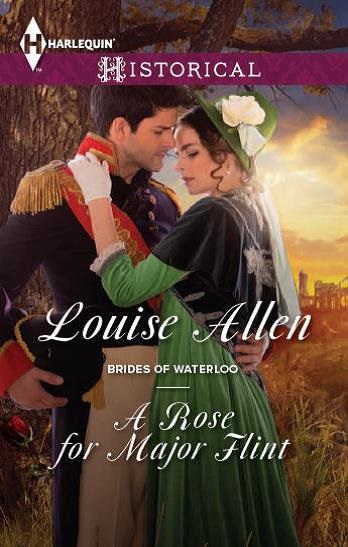
My latest book is the third in a Waterloo trilogy (The Brides of Waterloo, with Sarah Mallory and Annie Burrows.) My novel, A Rose For Major Flint, begins on the morning after the battle when my hero, Adam Flint, rescues my heroine, a traumatised, speechless young woman he calls simply, Rose, from a group of scavengers.

So, of course, I needed to know what it was like on the battlefield that morning. To my amazement I discovered that there were tourists on the field almost at first light, interrupting Captain Mercer and his artillery troop as they ate their breakfast amidst the carnage.

Soon I was accumulating first-hand accounts by travellers who, in some cases, arrived on the scene within days. From their words I knew what the battlefield looked like and smelled like and what the ground was like underfoot. I discovered what the state of the roads was and what was happening to the dead and injured and discovered tiny, heartbreaking details, such as the patches of wildflowers left amidst the carnage. I read about the gardener at Chateau Hougoumont who stayed throughout the battle and was found wandering through his wrecked gardens, bewailing the bodies amongst his cabbages, the farmer’s wife who was annoyed at the field hospital set up in her barns, but was quite pleased to have had a general nursed in her cowshed and the local peasants searching for items they could sell to the tourists – the beginning of a local industry that endures to this day. From that research came The Road to Waterloo: the first battlefield tourists 1815-1816.

A Rose For Major Flint                                                                                   To the Field of Waterloo


It is definitely a virtuous circle – my novels demand research, then the research gives me the facts, and more importantly the feel of what I am investigating, and from that I can produce non-fiction books that I hope add something deeper to my readers’ experience.

                                                                                   
Louise Allen’s 50th historical romance for Harlequin Mills & Boon comes out this year and she is also the author of five historical non-fiction titles. She lives on the North Norfolk coast with her husband and a garden full of bossy pheasants and travels as much as possible in search of inspiration and to escape deadlines.

@LouiseRegency

Louise, you will have touched many of us today with your references to Jane Austen, Regency London, Georgian road maps and Waterloo. It would seem your knowledge is encyclopaedic. Cue for another book?

The RNA Blog is brought to you by 
 
Elaine Everest & Natalie Kleinman

If you would like to write for the blog please contact us on elaineeverest@aol.com