Tuesday, July 14, 2015

Nora Fountain: Blackthorn Child


A big hello to Nora Fountain who is our guest on the blog today.
Nora, you have written short stories for the women’s magazine market as well as novels. What would you say is your favourite form of storytelling?
I prefer to write novels. I’ve written lots of short stories and sold some of them but it’s not really my thing. I very much admire those who can turn out short, snappy stories. I like to get my teeth into a story, with the freedom to develop characters, and more than one or two of them. I like to get inside their heads and become that character. The first draft is the bare bones of the story, then comes the best part, editing and polishing, going through several times, the characters developing each time till I know them like old friends. As they develop they suggest little twists and turns of their own. In the end I love them all – even the baddies. They are me. I am them, and I’m sorry to have to say good-bye to them.

Would you recommend that those new to writing try their hand at writing long and short fiction?
If they want to. I don’t think it’s always necessary. I always wanted to write longer, more in-depth stuff. However, I didn’t really have a clue when I started Blackthorn Child, which began life as Downton’s Heir (!) and grew with every rewrite until it reached 180,000 words. Fortunately I’ve always enjoyed the art of prĂ©cis but I’m now aware of the practicalities of producing such a long book. Publishers do not want to invest large sums in new writers.
I tried writing for M&B for a while, reading their authors voraciously. I loved writers such as Charlotte Lamb, Penny Jordan and Sara Wood. There was a seamless quality to their writing it is difficult to emulate. I did try, though, around a dozen times. On three occasions they read a partial and asked to see the rest. I was quite excited the third time but in the end it was turned down. I submitted one to Robert Hale, minus the steamy bits and it was accepted. Hurrah! They went on to take several more. These went into large print and translation in some cases. I carried on with full-length fiction and, to my delight, Thorpe bought Love Thine Enemy direct from me.

We’ve thoroughly enjoyed reading, Love Thine Enemy, Can we expect more historical novels from you with overseas settings?
I certainly hope so. Blackthorn Child went back and forth to agents and publishers till I changed tack and put it on Kindle. It soared to the top of three of their lists, occupying top spot for a while.
I am currently writing another historical set in Puglia where my youngest son lives, designing houses and teaching yoga. I have lots more research to do but I’m enjoying it. I’m also writing a contemporary romance set in Africa called Tropical Madness. It’s a year now since the accident that wrote off my car and broke eleven bones – a bit of a setback but I’m getting back in the saddle with interruptions for physio, etc. Perhaps I should write a hospital drama.
There are certainly a few health issues in Cupcakes and Candlesticks. This is my latest novella with a mature hero and heroine and set in the Dorset I love. When Rob announces he is leaving Maddy and their four children she is shocked but she picks up the pieces and forges a new life for the family out in the sticks. There she meets the gorgeous Guy Deverill, a landowner with angst of his own. I sold the large print rights to Cupcakes and Candlesticks to Thorpe and in the same week brought out the Create Space version of Blackthorn Child – or rather my son Basil did. He’s been a driving instructor for a couple of years but now has another string to his bow, offering services to novelists, formatting, putting on Kindle, etc. I’m no techie and couldn’t manage without him. My younger daughter played her part designing the cover for the paperback so it’s something of a family production.

Please tell us more about your five novels that are being reprinted by Samhain?
The American publisher Samhain have started a new line called Retro Romance. They’ve taken five of my novellas and given them gorgeous new covers which is all rather exciting. They can be viewed and are available on line from Samhain.

These days authors have to promote themselves on social media. How much time do you spend online? How does it help your work?
I probably spend far too long online, mainly Facebook where I have two pages, one an author page. I enjoy keeping up with news of my extended family- recently extended to include my first great-grandson, Alby Koa. Don’t ask. I’ve never heard of the names, either, but I do know he’s absolutely gorgeous with silky dark hair and eyes that will probably be brown. It’s great to hear news of other writers’ successes, too. I occasionally post on Twitter but I think I need lessons on using social media to the best advantage.
Nora Fountain is a professional writer and translator. Her short stories have been published by People's Friend, Yours, Australian Women's Weekly, Woman's Day and Fiction Feast, among others.
Her novels are mainly in the contemporary romance genre published by Robert Hale and My Weekly Story Library. Nora has also written historical romance. Her books are available on Amazon.
Five novels are currently being reprinted by Samhain as part of their Retro Romance series and are available from the publisher as ebooks.
Nora lives in Dorset and is a member of the Society of Authors and the Chartered Institute of Linguists, and is a committee member of the Romantic Novelists’ Association.
Links:
 
Thank you, Norah. It’s also good to hear you are well on the way to recovery after your accident.

The RNA Blog is brought to you by,
Elaine Everest & Natalie Kleinman
If you would like to write for the blog please contact us on elaineeverest@aol.com

Friday, July 10, 2015

Gilli Allan: Finding her Wings

Gilli Allan on her novel Fly or Fall and how she gave it wings

I didn’t go to university. I only studied English up to the age of sixteen, but I was always a story-teller. When I first decided to write seriously, I simply found a notepad and a pen, and started. It was only after I’d had two novels published that I began to take on board some of the ground rules of successful fiction writing. There are very many pitfalls and trip wires for the new author, and I’m sure I’ve fallen into, or over, most of them.   

‘Point of view’ was something I knew about, but only in the sense that I understood what was meant by this term.  I’d read and enjoyed many multi-faceted novels, told from a variety of viewpoints. But I hadn’t understood or mastered the skill and craft required to make such an approach work seamlessly. The vital importance of keeping a grip on POV was an aspect of writing that had simply not occurred to me.   

At the start of my writing career most women’s fiction was written solely in the third person, from the viewpoint of the heroine. I’m not a natural rebel so, for the majority of the action in my early books, I too followed the heroine, telling her story in the third person. But when there was something I wanted my reader to know, something my heroine had neither seen nor understood, I used a scatter-gun approach, going to whichever character was in possession of the facts. Head-hopping is a bad habit that very often afflicts novice writers, and I embraced it wherever necessary, but if I couldn’t use another random ‘head’ from which to convey important messages to the reader, I’d simply drop the information into the narrative. The use of the God-like authorial voice is yet another story-telling method disapproved of in contemporary commercial fiction writing (in literary fiction you can get away with anything.) And if there were things I didn’t want my reader to know yet, like the fact my hero really really fancied my heroine, I just kept quiet.

For very many reasons, which I won’t go into now, Fly or Fall, was written over a number of years. I started and stopped and started again. But at the time I began it, I was at least in possession of some newly absorbed wisdom about the craft of writing. Fly or Fall is a complex story with a larger cast of characters than I’d previously handled. I knew that each of the protagonists had a history, they each had flaws and failings, they each kept secrets. All, that is, apart from my heroine, Nell. She is straightforward, principled and honest. It never crosses her mind that others are not like her; that the people in her life might deceive and hide and lie. She’s not stupid, but her default position is to take life at face value - to believe others’ accounts of themselves. It’s not until halfway through the story that Nell begins to comprehend that she has been massively duped. Some of the deceptions are serious, some trivial, and in some respects she’s deluded herself. But, like a house of cards, take one support away and everything begins to topple. 

I had faith in my story, but although I was now very much more aware of what I was doing - solely telling the story in the third person, through Nell’s eyes - it sat leadenly and lumpily on the page. A plate of cold porridge springs to mind. One problem was the back-story. It was important. I needed to convey it. But it was complicated. There were far too many conversations of the “Didn’t you know that...?” variety. I realised I had to do something radical. I started by asking myself some ‘back to basics’ questions. For example, does Nell, and, by extension, my reader, really need to know this yet ... in fact, do they really need to know it at all? 

After the brutal cutting, I began to question the point of view. Not the direction from which the story is told, I knew it was Nell’s, but I wondered if the use of third person was hampering its direct communication to the reader. I put the whole of the manuscript into the first person - initially just to see what difference it would make.

It used to be an accepted wisdom that the readers of women’s fiction are resistant to novels in the first person. They won’t buy them in the same numbers, apparently. I don’t know if this is still true, but even if it is, getting the story right was far more important to me, than any theoretical commercial advantage. To my delight, when ‘she’ became ‘I’, Fly or Fall flew.

Fly or Fall follows the dismantling of all of Nell’s certainties, her preconceptions and her moral code. Unwelcome truths about her friends, her husband, her teenage children and even herself are revealed. Relationships are not what they seem. The hostility between brothers is exposed and finally explained. And the love that blossoms unexpectedly from the wreckage of her life is doomed, as she acknowledges the hair’s breadth between wishful thinking, self-deception and lies.

By the conclusion of Fly or Fall everything has altered for Nell, the woman who doesn’t like change. But she has rebuilt herself as a different person, a braver person, and she has embarked with optimism on a totally transformed life, a life that offers the chance of love
.
Blurb
Wife and mother, Nell, fears change, but it is forced upon her by her manipulative husband, Trevor. Finding herself in a new world of flirtation and casual infidelity, her principles are undermined and she’s tempted. Should she emulate the behaviour of her new friends or stick with the safe and familiar?

But everything Nell has accepted at face value has a dark side. Everyone - even her nearest and dearest - has been lying. She’s even deceived herself. The presentiment of disaster, first felt as a tremor at the start of the story, rumbles into a full blown earthquake. When the dust settles, nothing is as it previously seemed. And when an unlikely love blossoms from the wreckage of her life, she believes it is doomed.
The future, for the woman who feared change, is irrevocably altered. But has she been broken, or has she transformed herself? “


About Gilli Allan
Gilli Allan started to write in childhood, a hobby only abandoned when real life supplanted the fiction. Gilli didn’t go to Oxford or Cambridge but, after just enough exam passes to squeak in, she attended Croydon Art College.

She didn’t work on any of the broadsheets, in publishing or television. Instead she was a shop assistant, a beauty consultant and a barmaid before landing her dream job as an illustrator in advertising. It was only when she was at home with her young son that Gilli began writing seriously. Her first two novels were quickly published, but when her publisher ceased to trade, Gilli went independent. 

Over the years, Gilli has been a school governor, a contributor to local newspapers, and a driving force behind the community shop in her Gloucestershire village. Still a keen artist, she designs Christmas cards and has begun book illustration. Gilli is particularly delighted to have recently gained a new mainstream publisher - Accent Press. Fly or Fall is the second book to be published in the three book deal.

Links
Facebook:  

It’s been fascinating reading about how you found your own ‘voice’, Gilli. Thank you for joining us today

The RNA blog is brought to you by
Elaine Everest & Natalie Kleinman
 
If you would like to write for the blog please contact us on elaineeverest@aol.com


Tuesday, July 7, 2015

Louise Allen: From Fact to Fiction and Back Again

A truly fascinating account of what research can lead to from today’s guest, Louise Allen

I write historical romance, mainly Georgian-set, so I have every excuse for lots of fascinating (and work-postponing) research. My desk is heaped with books and original prints and my PC bulges with files of references and the big problem is knowing when to say “Stop!” and start getting on with the book.

A few years ago I had a light-bulb moment and realised that I could use the research I was doing for my novels and turn it into non-fiction, covering themes that interested me and which I hoped would also interest my readers. That led me to producing a book of Walks Through Regency London, which in turn led to Walking Jane Austen’s London (Shire) and a regular blog, also about Jane Austen’s London.

That, I thought, would be that, until I found myself wrestling with stagecoach timetables and Georgian road maps and lists of inns as I tried to plot my heroine’s journey as she first of all eloped, and then fled from her lover, in From Ruin to Riches. What I could not find was a book about the experience of stage and mail coach travel for the passengers – so I wrote one, Stagecoach Travel (Shire). Both experiences – the London walks and the stagecoach research – led me to even more fiction plots and a real feeling of closeness with my characters as I clambered in and out of stagecoaches, or had a conversation with a gas-lamplighter in an atmospheric alleyway in St James’s. (Yes, there really are lamplighters left in modern London.)

Researching stagecoach travel made me wonder how much of the most famous of the coaching routes, the Great North Road, can still be found, so my husband and I set out to travel it and found the inns and the old bridges, the spots where highwaymen were hanged and terrible coach accidents happened – and a deserted graveyard with the headstone of a man killed in a duel with his close friend. Once more my notebooks filled up with plot and character ideas and I felt more and more in touch with the travellers of the time.

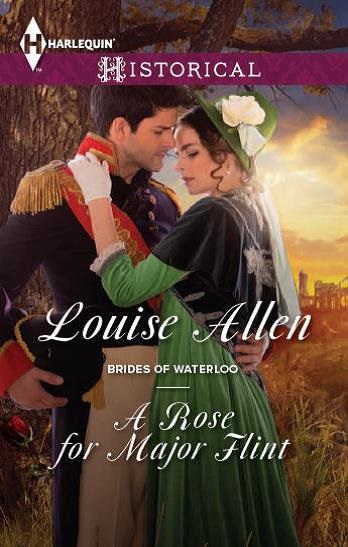
My latest book is the third in a Waterloo trilogy (The Brides of Waterloo, with Sarah Mallory and Annie Burrows.) My novel, A Rose For Major Flint, begins on the morning after the battle when my hero, Adam Flint, rescues my heroine, a traumatised, speechless young woman he calls simply, Rose, from a group of scavengers.

So, of course, I needed to know what it was like on the battlefield that morning. To my amazement I discovered that there were tourists on the field almost at first light, interrupting Captain Mercer and his artillery troop as they ate their breakfast amidst the carnage.

Soon I was accumulating first-hand accounts by travellers who, in some cases, arrived on the scene within days. From their words I knew what the battlefield looked like and smelled like and what the ground was like underfoot. I discovered what the state of the roads was and what was happening to the dead and injured and discovered tiny, heartbreaking details, such as the patches of wildflowers left amidst the carnage. I read about the gardener at Chateau Hougoumont who stayed throughout the battle and was found wandering through his wrecked gardens, bewailing the bodies amongst his cabbages, the farmer’s wife who was annoyed at the field hospital set up in her barns, but was quite pleased to have had a general nursed in her cowshed and the local peasants searching for items they could sell to the tourists – the beginning of a local industry that endures to this day. From that research came The Road to Waterloo: the first battlefield tourists 1815-1816.

A Rose For Major Flint                                                                                   To the Field of Waterloo


It is definitely a virtuous circle – my novels demand research, then the research gives me the facts, and more importantly the feel of what I am investigating, and from that I can produce non-fiction books that I hope add something deeper to my readers’ experience.

                                                                                   
Louise Allen’s 50th historical romance for Harlequin Mills & Boon comes out this year and she is also the author of five historical non-fiction titles. She lives on the North Norfolk coast with her husband and a garden full of bossy pheasants and travels as much as possible in search of inspiration and to escape deadlines.

@LouiseRegency

Louise, you will have touched many of us today with your references to Jane Austen, Regency London, Georgian road maps and Waterloo. It would seem your knowledge is encyclopaedic. Cue for another book?

The RNA Blog is brought to you by 
 
Elaine Everest & Natalie Kleinman

If you would like to write for the blog please contact us on elaineeverest@aol.com


Monday, July 6, 2015

Theresa Le Flem: The Gypsy's Son


Today we welcome, Theresa Le Flem to the blog to tell us why she decided to venture into self-publishing.
My first two novels were published by Robert Hale Ltd, which was thrilling. My third, The Gypsy’s Son, marks my first venture into self-publishing. I was beginning to feel quite down actually.  When my new novel was declined, after submitting to agents and other publishers, (and experiencing once again that endless waiting) the rejections hit me hard. I felt I was back to square one.
However, self-publishing for me has been a revelation. To be in control of everything to do with how my ‘baby’ enters the world is a wonderful experience! Following the invaluable advice of other RNA members, (Thank you Romna!) I decided to go through CreateSpace. Confident I could probably come up with a cover design myself, and with a lot of perseverance, i.e. watching You Tube videos and reading books on ‘How to Self-Publish…’ I’ve finally got there. I can certainly recommend the journey. It’s so rewarding and worth the time spent in front of the computer. Publishing is all about choice these days – and who knows better how to present a novel than the author?

Tell us something about yourself?
I grew up in an artistic, creative household in London which was busy with visitors. My family moved house several times but the move that made a lasting impression on me was to Cornwall. This was the setting for two of my novels, the most recent, The Gypsy’s Son, is published this month. I live in the Midlands, England, with my husband Graham (chief proof-reader & ‘computer error’ rescue person!) and our greyhound. I write Romantic Fiction with an edge.
It may be a fact that an unsettled, poverty strewn life can produce a spark that starts the fire of creativity. This is true in my case, I believe. Having come through difficult times, now I’m happy and settled I can look back and draw from those difficult experiences in the past. In my writing I like to explore the challenges people face in everyday life. This is why my first hero was a coal-miner - no dewy eyes or blushing brides for me I’m afraid! My novels are emotional, romantic, moving, but realistic. Having had a string of jobs, I’m now fortunate to be able to write full-time – a dream I have had since I was a child.

What gave you the idea to write a novel about gypsies?
It was a postcard! At the time I was deep into writing The Forgiving Sand but felt isolated too. I joined my Adult Education Centre to meet other writers. The tutor spread a heap of postcards, mainly from the Portrait Gallery, on the table and said, “Choose one – and create a story!” The face that appealed to me looked like a gypsy’s face. I didn’t complete the course, I was too busy writing!  

Do you have any family connections with the Romany community?
No, I can’t explain why I feel such an affinity with them except that I often empathise with those who are oppressed. The gypsies in my novel are those of ‘the old days’. It begins in 1953 when they still travelled about in horse-drawn caravans, living close to nature and enjoying the freedom of the open road. It must have been a tough life. Though uneducated academically, they practised crafts we would be envious of today. They were not, I believe, like the modern travellers portrayed in the media these days who get a very bad press, often unfairly. But I can identify with their restlessness, their need to move on. I’ve moved house many times; twenty-five times at the last count! It’s time I settled down
.
Does this novel have a ‘hidden message’?  We sensed your first two carried an undercurrent, a social comment about society.
I do tend to write about, as one reader put it: “people who live on the edge of society.” For example, in The Sea Inside His Head I took the side of the ‘scab’ during the Miners’ Strike and explored the effect the strike had on their marriage. The miner’s story is very poignant. I dislike injustice and generalisations, especially when public opinion suggests what is acceptable and what isn’t. The newspapers almost dictate what reaction we, the ‘general public’ should have to a news item.  I prefer to decide for myself.

Why have you chosen to go independent and publish this yourself?
Perhaps because of the reasons given above. It wasn’t acceptable to a publisher. Who wants to buy a book about a gypsy? I don’t know but I’m going to find out! When I heard that The Gypsy’s Son had been declined I was upset at first. I felt like the rug had been pulled out from under me. I know lots of authors in the RNA have gone down the self-publishing route and seen how successful they have been and I’ve received loads of encouragement. It’s such a huge subject in itself I could take up the whole interview with it! I’ve learnt so much along the way, now I wouldn’t hesitate to do it again.
Is The Gypsy’s Son a romantic novel too?
Yes, it’s a love-story with angst. As a young man, my hero, Finn, goes through such a lot. There’s fear and passion in his dark eyes.  I researched more for this story simply because unlike the other two novels, I’ve had no personal experience of the gypsies. Once I began researching Romany Gypsy folk-lore and way of life I was absolutely fascinated. I’ve attempted to describe the essence of what I believe to be a gift certain people have  – an insight into things which are...how can I say it? Spiritual? I don’t know how to explain it in the cold light of day. It has to be put over in fiction, in atmosphere, emotions and feelings, and it’s quite personal. That’s why I’m a novelist I guess.

Thanks so much for inviting me for an interview. I’ve really enjoyed it.
Links:
Website    
   
Thank you for joining us, Therese and good luck with The Gypsy’s Son.

The RNA Blog is brought to you by,
Elaine Everest & Natalie Kleinman
If you would like to write for us please contact us on elaineeverest@aol.com

Sunday, July 5, 2015

RNA Conference: Do’s and Don’t’s


For everyone attending this year’s conference we have invited NWS Organiser, Imogen Howson, to give a few pointers on what to expect and how we should conduct ourselves in the pursuit of a publisher or agent.

In the RNA, we’re very fortunate that agents and editors often attend our events.  This year’s conference, being in London, will have more industry professionals than usual—and lots of authors ready to take advantage of their expertise!

But, for an author who doesn’t yet have an agent or editor of their own, it can be intimidating to find yourself next to one at the bar or at the dinner table.  What should you do—ply them with gin and then forcibly thrust your manuscript into their hands, or give them one terrified look and slink away before they can speak to you?

Neither, hopefully!  Read on for a list of do’s and don’t’s for meeting agents and editors.

  • Do be friendly.  No one comes to an RNA conference if they’re unwilling to talk to authors.  The atmosphere is usually very relaxed, and everyone will be happy to chat to you, even if they have to stare at your chest (I mean name badge) to work out who you are.

  • Don’t worry about feeling shy.  A huge number of writers are shy, or introverted (or both).  It’s absolutely fine to start a conversation by saying, “Can I talk to you?  This is my first conference and I don’t know anyone.”  Or even, “Can I sit with you?  This is my sixth conference and I can’t remember who anyone is!”

  • Do talk to anyone you meet, feel free to sit at tables that are already partially occupied, strike up conversations in the lunch queue, and sit next to strangers in the talks and workshops.

  • Don’t interrupt an obviously private conversation.  If an editor/agent is head down in conversation with another author, try not to interrupt.  The conversation might be between an author and their own editor/agent, or it might be that author’s one chance to pitch their book to their dream agent.  Find someone else to chat to in the meantime.

  • Do come prepared to talk about your book if asked.  Everyone you talk to will probably, at some point, ask what you write or what you’re working on at the moment.  If this person is an agent or editor, and you’ve prepared a few-sentence pitch that describes your book in a short, “hooky” way, you’ll be so pleased with yourself afterwards!  If you have to ramble for ten minutes, forget your heroine’s name, and go away realising you forgot to explain the main conflict, you won’t be so pleased.  A little bit of practice before the conference could pay off beautifully—and even if it doesn’t, it’s good practice for future events!

  • Don’t do a hard-sell of your manuscript.  It’s absolutely fine to talk about your book at an appropriate point in the conversation, but plunging straight into your pitch isn’t the best way to begin.  And trying to insist that someone look at your book even if they’re showing no sign of interest, or have already said they don’t represent/publish that type of fiction, isn’t a great idea either.

  • Do be aware of the genre, length and type of your book.  If a publisher only publishes short, light-hearted romances, they’re unlikely to be interested in a 100-word-plus gritty crime thriller, even if it does contain a romantic sub-plot.  That doesn’t mean you shouldn’t tell them about it if asked, but do remember that they’re unlikely to ask to look at the manuscript.  And don’t try to persuade them—they know what they can sell, and if your book wouldn’t do well with them, you don’t want to be published with them anyway!

  • Don’t try to give agents or editors a copy of your book.  (Especially not a printed copy—nobody wants their luggage to end up heavier than it starts!)  Editors and agents have different submission guidelines, which they need authors to adhere to.  It’s not usually useful to them to be given a copy, whether print or on a flash drive.  If an agent or editor would like to see your book, they’ll probably give you their business card or email address or direct you to the submissions guidelines on their website. 
Finally:

  • Do come to the NWS session on Saturday morning.  Imogen Howson, the NWS Organiser, will be there to answer any questions or concerns you have.


About Immi:


Immi combines writing young adult fiction, working as an editor for Samhain Publishing, and running the New Writers Scheme. Her latest book is Unravel, a YA science fiction romance. When she’s not writing, editing or taking NWS parcels to the post office, she drinks coffee, runs, cuddles cats, hamsters and teenagers (her own, not other people’s), and collects Sweet Valley High and Chalet School books. She can be found at www.imogenhowson.com and twitter.com/imogenhowson


Do you have any tips to add to Immi’s? Please add them in our comments section below.

Thank you, Immi. We are sure this will be extremely helpful to those attending.
 
Have a good Conference!
 

Elaine Everest & Natalie Kleinman

Friday, July 3, 2015

Liz Harris: Essential Research!


Liz Harris visits the blog today to show what hard work research can be when planning a novel.

Evie Undercover, a contemporary romantic comedy set in Umbria and London, is the first romantic comedy I’ve written. My previous full-length novels, The Road Back, A Bargain Struck, and Golden Tiger, which comes out in autumn 2015, are historical romantic fiction, so Evie Undercover was quite a departure.
Apart from the difference in tone, the greatest difference lay in the nature of my research. For my historical novels, I read up on the period, and in the case of A Bargain Struck, went to Wyoming to learn more than books alone could tell about the life-style of second generation homesteaders.
But for Evie Undercover, I had no need of historical tomes, visits to museums or hours spent in libraries--there was only one place I needed to go, and that was Umbria. Needs must, I nobly thought, and I packed my bags and headed for the airport, clutching an online ticket for Perugia.
I had my hero: handsome lawyer, Tom Hadleigh; I had my heroine, enterprising Evie Shaw, on her first assignment from Pure Dirt, the only magazine that would take her on after months of searching, so all I needed was the setting.
 
Forcing myself into restaurant after restaurant in order to decide where to send Tom and Evie; sitting in the piazza in the medieval town of Todi, sipping prosecco while watching the stone walls of the 14th century cathedral change colour during sunset; walking the streets of the ancient city of Perugia. Yes, there was nothing I wouldn’t undertake in the name of authenticity!
So I had my hero, my heroine and my setting—all I needed was a page-turning story. Evie and Tom gave me that. It started the first night they were in Italy. Anyone who could play the trick that Evie played on Tom… . But Evie had one week only in which to achieve her goal, and failure wasn’t in a word in her book!
 
Blurb:
When libel lawyer Tom Hadleigh acquires a perfect holiday home, a 14th century house that needs restoring, there’s a slight problem. The house is located in the beautiful Umbrian countryside and Tom can’t speak a word of Italian.
Enter Evie Shaw, masquerading as an agency temp, but in reality the newest reporter for gossip magazine Pure Dirt. Unbeknown to Tom, Italian speaking Evie has been sent by her manipulative editor to write an exposĂ© on him. And the stakes are high – Evie’s job rests on her success.

Pour a glass of prosecco, sit back and enjoy. An ideal summer read!

About Liz:
Liz was born in London. After graduating with a Law degree, she moved to California where she led a varied life, from waitressing on Sunset Strip to working as secretary to the CEO of a large Japanese trading company. When real life intervened, she returned to the UK, completed a degree in English and taught for a number of years.

Liz is published by Choc Lit. The Road Back, A Bargain Struck and Evie Undercover are published in paperback, and The Art of Deception and A Western Heart, a novella, are published as ebooks. She has a short story in each of the Choc Lit anthologies

Liz now lives in Oxfordshire. She is a member of the Historical Novel Society, the Oxford Writers’ Group, and is the convenor of the Oxford Chapter of the RNA.

Links:
Twitter: @lizharrisauthor
Facebook: Liz Harris.
 
Liz, we thoroughly enjoyed your blog post. If the RNA blog falls silent it is because the team are on a world cruise planning our next novels…!
 
The RNA blog is brought to you by
Elaine Everest & Natalie Kleinman
 
If you would like to write for the blog please contact us on elaineeverest@aol.com

Thursday, July 2, 2015

Anna Jacobs: Turning Seventy!


 We have a treat for blog followers today as Anna Jacobs tells us about her writing career.
In January 2015 I had my 70th novel published. I’m in my 70s too, so it seems a lucky number for me.

 When I got my first novel accepted in 1992, I sat and thought about my future career. I was 50 then, so I figured I might manage to get 10 novels published before ‘the end’. After all, it’d taken me ten years and six books written to get to this stage.
I smile now at that naĂ¯ve analysis, but in the days before the Internet it was far harder to get information. I was very wrong about the numbers. The years before 1992 had been spent learning my craft; the years since have been spent using and developing my skills – and learning to write far more quickly.
It wasn’t that I knew everything about writing novels by the time that book was accepted, but that I knew enough to write to a professional standard. Those are the two key words. I’m really glad I’m not starting as a writer now, particularly glad I wasn’t able to rush to self-publish when no publisher wanted my first ‘darling’. Because that made me work even harder to hone my skills.
My first story is the only one of those six books that I haven’t rewritten and had published. Why not? Because it doesn’t deserve it. Writing that story taught me so much and it was an incredibly valuable exercise. But oh dear, it has an extremely trite plot and a lot of errors in how it was told. RIP.
One of the best things about being a novelist is that you never know it all. There’s always something you can do better next time. I absolutely love that.
My agent said I seem to have moved to a different level with my latest series, which starts with ‘A Time to Remember’. That remark from an expert made me beam with delight all day.
So, to sum up, I’m in my 70s, I’ve just had my 71st novel published and I’m still learning. What a wonderful job this is!
Oh, and I’ve revised my estimate of how many novels I plan to write. I have so many ideas that I’ll need to live to at least 120 to tell all those stories. What fun!
 

Anna’s two ‘70s’ books so far:
 
A Time to Remember is set just after World War 2. It’s a historical novel, they tell me. It doesn’t feel like that to me, because I remember those times with a child’s eye. It’s the first of four novels set in Lancashire. Mayne is about to lose his family’s ancient home because his father has lost the family money. Esherwood was requisitioned during the war and is in a mess. All Mayne can do to save it is convert the old house into flats. Judith’s brutal husband is about to return from his posting overseas and she needs to get away. Both of them discover secrets that will tear their lives apart and yet, may offer hope for the future.  


Legacy of Greyladies is the third and final in the series, set on the Home Front during WW1. Phoebe Latimer is holding the fort at Greyladies while her husband is serving in the army. But someone is targeting the old house—and Phoebe—in order to get rid of the German internees. Her life is at risk, and that of her unborn baby. Olivia is helping found the new Women’s Institutes in Wiltshire and loves the old house on sight. Can Alex help the two women save the old house and the friendly ‘enemy aliens’?


About Anna:
Award-winning author Anna Jacobs writes both historical and modern romantic novels about families and relationships, producing three novels a year. January 2015 saw her 70th novel published and she’s the 6th Most Borrowed Author of Adult Fiction in the UK, and is similarly popular in Australia.
You can find out more about Anna’s books on her website. Each of them has a separate page, where you can read the first chapters and find about what gave her the ideas for the various stories. Go to:
You can also read the latest news on her Anna Jacobs Books page on Facebook

Thank you, Anna, for such an interesting insight into your writing life. We both agree that a writer never stops learning.

The RNA blog is brought to you by
Elaine Everest & Natalie Kleinman

If you would like to write for the blog please contact us on elaineeverest@aol.com


Tuesday, June 30, 2015

Nikki Moore: I wish I had time to write a book...!


 Welcome to Nikki who has found time in her very busy schedule to write for us. Whatever you do don’t tell her you have no time to write…

Over the years I’ve heard that many times. Should I admit that it both sets my teeth on edge and fills me with amusement? Probably not! But here’s the thing – writers have the same twenty-four hours in a day as everyone else. We don’t have a magic wand that makes time stand still at midnight (oh, how I wish I did). Many writers have day jobs, bills to pay, friends to see, children to raise, family to care for, housework to do, gardens to tend and everyday stresses to deal with.
The demands of being a published author are numerous. It’s not just the bum on seat, fingers on keyboard time hammering out a first draft. There is also research and (sometimes substantial) rewrites before the manuscript gets anywhere near your agent/editor/beta reader. Then there are the edits and the promotion that’s required of an author nowadays. You can spend hours on the radio, TV or social media trying to drive sales and get your name, brand and title of your newest release in front of readers, bloggers and reviewers. There might also be social events to attend for networking purposes, sometimes at your publisher’s request, and their needs have to be taken into account so that you meet their deadlines to hit the right market at the right time. There is all this and more, so when people say to me, ‘I wish I had time to write a book,’ what I tell them is this I can’t imagine not writing, it’s something I have to do. I’m lucky to be an author and I love it. I’m grateful for every review and all the support I’ve had in my writing career so far. But I don’t have time to write books. I make time. I make writing a priority, sometimes lower down the list than I’d like, but a priority nonetheless. Time that I could otherwise spend watching TV, reading, scrubbing behind the toilet or ironing (I buy crease-free clothes and let them hang!) is spent on writing instead.

I work full days in Human Resources over a nine day fortnight, meaning I get two Fridays off a month as dedicated writing time. I’m a single mum with two kids, one of them a teenager. They see their dad regularly but are with me day to day. Sometimes I write between 6.00 – 7.00 a.m. before the school run, but usually it’s after my youngest has gone to bed from 9.00 p.m. until I fall asleep over the laptop. I do this at least three times a week but it can be closer to five or six evenings and weekends too if I’m up against a deadline. Sometimes I fling food at the kids and tell them I’m neglecting them for a few hours, before closeting myself away. Mostly they accept this with good grace, as does my lovely boyfriend, who is more patient than I deserve. My friends and family also accept falling by the wayside if I have a deadline. Equally, housework drops from my usual gold standard to bronze level. It’s a delicate act to keep all the plates spinning but if I keep moving, I’m usually okay!
I asked other RNA members how they find time to write and to share tips.

Jules Wake, whose last release is From Italy with Love (HarperImpulse) works four days a week, volunteers at a local theatre, has an active social life and two teenagers. She suggests setting realistic goals and sticking to them. ‘Usually when writing a first draft, I aim to write 1,000 a day for five days out of seven. That's realistic because it gives me two days not to get any writing done.’ She’s written a book a year for the last five years and wrote an 87,000 word novel in seven weeks this year!
Bestselling author Katherine Garbera’s latest release is Carrying A King’s Child (Harlequin Desire/Mills&Boon Desire). She usually writes Monday through Friday from 9.00 a.m. – 3.00 p.m. around the school run, managing a chapter of around 3000 words every day by being disciplined about her writing time and not spending too long on social media. ‘I also use the timer to jumpstart my writing on the days when it feels more like a job than fun. I set it for ten minutes and tell myself I have to write for those ten minutes.’ With this routine she writes an amazing 4-6 books a year.

Jenni Keer, who attends the Chelmsford RNA Chapter and was shortlisted for the Choc Lit 'Search for a Star' competition, has four sons and cares for her elderly mother. Her husband works irregular shifts and she writes around the school day. ‘For me, family will always come first, but writing is now a definite second. Housework, socialising, helping out at the school and even my lovely garden are all things that have dropped down the list. I don't need to live in an immaculate house but I do need to get this current novel finished!’

Elaine Roberts has had over a dozen short stories published since joining the RNA New Writer’s Scheme and Elaine Everest’s writing classes. She is currently working on her novel The Legacy. She works 35 hours per week for a Local Authority and is an active grandparent. ‘My time is very precious. Every second counts. I am thankful for having an understanding and supportive husband who has basically taken over the household chores, freeing up my evenings and weekends to spend on writing.’

Elaine Moxon’s (writing as E S Moxon) debut novel WULFSUNA is out now with SilverWood Books. She is a mum, writer and community volunteer and doesn’t set weekly word count goals or set specific writing times. ‘I simply have a personal agreement to each week set aside some time for writing. I limit events to no more than once a month and use evenings and weekends for promotion at key times.’

Susie Medwell’s latest release writing as Zara Stoneley is Country Affairs (HarperImpulse). With wedding plans, supporting her son through A' levels, flying out to see her fiancĂ© in Barcelona and working two days a week, her writing schedule has been disrupted recently but she always aim for an impressive 10-12k words a week. She knows how to make the best use of her time. ‘My ‘planning brain’ works best in the mornings so I try to schedule things so that I do this on my non-office days. When I’m writing the words tend to flow faster in the evening so I often work until quite late, I also find it easy to write at the airport/on the plane.’

So what are you waiting for? You can write a book too if you want to badly enough… Good luck!


About Nikki:
 A Dorset girl and RNA member, Nikki Moore has a HR day job, two kids and a lovely boyfriend to keep her busy alongside the writing. Published mainly by HarperImpulse, she’s the author of the #LoveLondon series and has a story in the bestselling RNA/Mills & Boon anthology Truly, Madly, Deeply. Nikki’s debut novel Crazy, Undercover, Love was shortlisted for the RNA Joan Hessayon Award 2015 and she is a strong supporter of aspiring authors. The last in the #LoveLondon series Picnics in Hyde Park is due out later this summer.

Please pop over and make contact via Twitter @NikkiMoore_Auth or on Facebook at https://www.facebook.com/NikkiMooreWrites

Thank you, Nikki. This shows the dedication to writing from our members.

The RNA Blog is brought to you by:

Elaine Everest & Natalie Kleinman  (who are also busy writing!)

If you would like to write for the blog please contact us on elaineeverest@aol.com