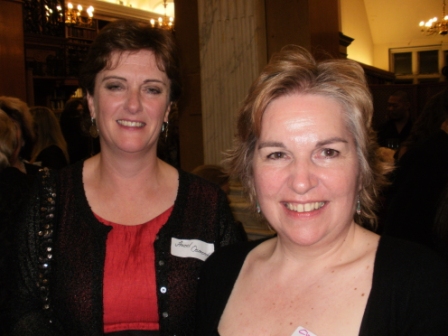
Friday, November 25, 2011

Author Interview with Gwen Kirkwood

Scottish based author, Gwen Kirkwood, has been involved with farming all her life. Her knowledge and love of country life gives depth to her warmhearted family sagas set in rural Scotland.

Tell us what made you want to write and how you got your first break?


When I first left home telephones were only for emergencies, so my weekly letters were long and newsy. My mother often said, "You ought to write a book".
My first attempt at adult fiction was entering a Woman's Weekly competition for a first chapter and synopsis judged by Woman's Hour and Woman's Weekly. I didn't win but Lynda O'Byrne, the WW fiction editor, wrote to say she had enjoyed my entry. She suggested I finish it and send it to Robert Hale. I wrote by hand and laboriously typed it with help from Mr Tippex. It was too long for the Hale Rainbow Romance Series and I assumed this was a rejection. Months later a letter arrived asking if my submission was ready. I had an almighty scramble to re-write and re-type. I wrote three more Rainbow Romances.
I didn't know any other writers and I was very naive. I chose an agent from Writers' and Artists' Year book. The first was full up. The second, chosen at random for her name of "Heather", sold Fairlyden to Headline with a contract for three more. I learned a tremendous amount from the editor and copy-editors. I knew nothing of the RNA until I was invited to join. I learned about the business of writing and publishing from the quarterly magazine. Later Romna began a weekly digest. Wendy Wootton and Shirley Worrell helped me get to grips with the internet and I no longer felt isolated. There is always someone willing to help or advise on Romna.

What is your favourite mode of working? What is your work schedule?

I prefer my own quiet office. Sometimes I have dreamy music playing in the background. When I began I had a husband and young family and life was hectic. Writing time was snatched. I kept a notebook and pencil in the cutlery drawer, beside the iron, in the bathroom, beside the bed, in my pocket when outdoors. I jotted down ideas and thoughts which jumped into my head. A tip for busy people - jot down a few words for the next passage before you stop. It helps you pick up the thread again.
I had a six year break from writing (for publication) when my husband died. The farming business provided the "bread and butter" for employees as well as my son and younger daughter. These days I am supposedly retired. I usually write each morning, and some times in the evening when a passage is clamouring to be written. I write straight to the computer. Cut and paste is a blessing!

How do you begin when you start a new novel?

When I start a new novel it has usually been incubating in my head for a while. I write the names and of places and main characters, physical characteristics, dates of birth. (needed in a series). I know roughly how the novel will end up but the journey is still a mystery which unfolds as I go along. I note details of other characters as they appear. I cannot work to a detailed plot. I enjoy creating a fictional world and the people in it. The first draft of a novel, especially the middle, is the most difficult but I enjoy the second draft, editing, strengthening plots, or characters, making waves to add tension and increase pace. I like to research and include real life events.

Do you believe writing is a skill anyone can learn? What advice would you give to a new writer?

Not everyone has a natural talent for story telling, or the craft for putting it together in writing. I believe writing has to come from the heart, with the determination to keep going, but be willing to listen to advice from experienced critics. I am constantly learning and changing. Two tips I wish I had known earlier. One is how to grip the reader's attention early - the first sentence if possible. When reading the revised draft if an incident jumps out at you, even if it is the third chapter, be ruthless. Start your story there, feed in the earlier passages if, or when, required. The second tip came from the last chapter of Stephen King's book "On Writing". He does not believe in using adverbs. Now I am conscious of them and amazed how often I can cut both adverbs and adjectives without detracting from the story, and often improving it.

In what way has the RNA helped you or your career?

At the York Conference in 2000 the RNA resurrected the Elizabeth Goudge Trophy. The competition was for the first chapter of a historical novel judged by Richard Lee. I won, with Margaret James as a close second. It kick started me into writing again. Thank you RNA. I finished the novel. The following year at the Cheltenham Conference I met Dorothy Lumley of DLA who is now my agent. I have written 11 more sagas and 2 shorter romances since then.

Do you find the increasing amount of time a writer has to spend on social networking and blogs a distraction from your writing, or of benefit?

I have a lot to learn about media and marketing. I have contributed occasionally to the RNA Historical Blog since 2009. Recently I joined four other novelists at http://novelpointsofview.blogspot.com where you can see my changing choices in books. I have joined Facebook and Twitter (@kirkwoodgwen) and started a blog of my own but if anyone reads it you may find as much about farming, gardening and family affairs as writing - but these are the things which make me the way I am and influence the way I write.


Do I suffer from writer's block?

Usually I can work things out in my head when the house is quiet and I am lying relaxed in bed, ready to sleep. As a child my imagination was always most vivid at bedtime.

With the increasing popularity of ebooks, how do you see the future for writers?

Whether we like it or not I believe e-books are here to stay. I have uploaded some of my early romances and intend to upload my first four sagas soon because they are out of print and I have the copyright. Hopefully digital editions will keep books available, and affordable, and I like that idea. Most publishers seem to be including digital rights in contracts now, but I still like the sight and feel of a "real" book with an attractive jacket.

Thank you very much Gwen for taking the time to talk to us and for sharing some excellent writing tips.

To find out more about Gwen and her work visit her website at www.gwenkirkwood.co.uk

Follow Gwen's blog at http://gwenkirkwood.blogspot.com


Thursday, November 24, 2011

Sue Moorcroft Shares Choc Lit's Short Story Competition


The details...

CHOC LIT SHORT STORY COMPETITION         

Choc Lit are looking for short stories of up to 1,500 words in which the central theme is chocolate - eating it, drinking it, cooking with it, or anything else. Let your imagination take flight!

PRIZES
1st prize £200, publication on the author’s corner blog and a box of organic chocolates from Plush
A Runner Up will receive £50 and a box of organic chocolates from Plush

RULES
1.       Your entry must be a maximum of 1,500 words.
2.       All work must be your own and not previously published.
3.       The entry fee is £3 per story
4.       All entries must be received by 31st January, 2012.

JUDGES
Your judges are Choc Lit authors Margaret James (The Silver Locket, The Golden Chain) and Sue Moorcroft (Starting Over, All That Mullarkey, Want To Know a Secret? and Love & Freedom). Both authors teach creative writing for the London School of Journalism and have published numerous short stories, including in the Romantic Novelists' Association's short story anthology. Both have regular columns, Margaret in Writing Magazine and Sue in Writers Forum.

HOW TO ENTER
1.       Please post your stories to: Short Story Competition, Choc Lit Ltd, Penrose House, Crawley Drive, Camberley, Surrey GU15 2AB. Please enclose a cheque for £3 per story - i.e. to enter 3 stories costs £9. Cheques are payable to ‘Choc Lit Ltd.’

2.       Or email info@choc-lit.co.uk with the subject header ‘Short Story Competition’ and pay your entry fee by Paypal atorders@choc-lit.co.uk.

Tuesday, November 22, 2011

Author interview with Lynda K Scott

A warm welcome to American author Lynda K Scott who writes for a genre which combines her love of science fiction, fantasy and romance.


Tell us about when you sold your first book.
My book, Heartstone, is available from Mundania Press which has quite a good following for science fiction, fantasy and paranormal books and has spread out to include romance. When I got the notification, I was elated. Couldn't stop grinning. And I immediately sent out email to all my friends that it had, at last, found a home.

Where is your favourite place to work?
I have a somewhat messy office I share with my kitten, Wookie. That's my favorite place to work because I can go in there, turn on the radio/cd player and close the door. The only one who's allowed to disturb me is Wookie but since she's my writing partner, I suppose that's all right.

Do you have to juggle writing with the day job? What is your work schedule?


I recently gave up my day job so I don't have to juggle anymore. Now, I have to adhere to a schedule that keeps me writing, otherwise I'd get too interested in playing with the Internet or working in my garden or...shopping.

How do you begin when you start a new novel?


I usually begin somewhat ahead of the story's actual beginning. That way I can give a little back story or history in for my characters. I know I'll delete it before I try to sell it because I don't want to bore my readers.

Which authors have most influenced your work? And which do you choose to read for pleasure?


Andre Norton and Isaac Asimov were my early influences. Both had romantic elements in their work. Ms Norton's style was spare, not a word wasted. She had a skill that led to graceful writing that lured a reader in and keep them firmly attached to the book. Dr. Asimov gave his science fiction stories real people which is what fiction stories are about. I like to think that what I've done is combined fantasy and science fiction with romance to get a genre I call Science Fantasy Romance. I'm not going to say that I created the genre or coined the name for it but that is what I write.

What is the hardest part of the writing process for you?


The hardest part of the writing process for me is to NOT include every single bit of information that I've learned during the book's research. I love research and I love learning and I'm sure most readers do as well. But an author can get off the path easily by looking for ways to incorporate each datum that comes her way. That's my burden and I have to fight it every day.

How do you develop your characters? In historicals, how do you keep them in period yet sympathetic to readers?


I begin with a physical description. Some tiny oddity will make me wonder how or where that physical trait came from. It's amazing how fast a character can grow when you begin expanding on something as simple as a tiny scar just below an eyebrow. While I don't write historicals, per se, many of my characters sound as if they're from a time period other than our own. Sometimes they are. Sometimes they're simply from another place with the values or mores of an earlier time period. To keep a character sympathetic to a reader you have to make the character someone the reader will sympathize with or one whose goals and motivations the reader can understand.

What do you think an editor is looking for in a good novel?


I think an editor looks for a solid story and great, motivated characters.

How do you relax? What interests do you have other than writing?


I love to cook and create recipes. I also can produce from my garden or from our local Farmer's Market. And I love to read.

Do you believe writing is a skill anyone can learn? What advice would you give a new writer?


I think many writers have an innate skill but without the proper nurturing of it by reading and studying good writers, it will likely wither. My best advice to new writers is to read, read and read some more. Then practice writing. Follow that up by more reading. Read the genres that interest you but also read genres that aren't quite your cup of tea. While you read, study how these successful authors developed their characters or plots, used dialogue or descriptive narrative. There's a lot that can be learned just by reading and it's fun!

What draws you to your particular genre? Are you a specialist or do you have another identity?


I love stretching my imagination. I love mythology. I love science. My novels follow the Arthur C. Clarke quotation: Any sufficiently advanced technology is indistinguishable from magic. Heartstone has shapeshifters who wield laser swords, fly space ships, and have interplanetary transport locations. They heal/diagnose with 'magical' stones or by touch. Altered Destiny has alien 'Elves', dragons, space flight, altered time lines and other cool stuff. My goal is to make the 'magic' plausible and the science understandable without sacrificing the story or the characters.

Do you enjoy writing sequels or series? If so, what is the special appeal for you?


Both Heartstone and Altered Destiny could have sequels...if I could halt the flow of ideas springing into my mind for new stories.

Do you find the increasing amount of time a writer has to spend on social networking and blogs a distraction from your writing, or of benefit?


There's no question that social networking takes time. I do believe social networking or blogs are important for a writer who has published books. With the way publishers are so cash short, we authors have to do whatever we can to get word out about our books. I also think social networking and blogging is fun. I've met a number of really sweet people who if they just lived a little closer would probably be close friends.

Do you ever suffer from writer’s block? If so, how do you cope with it?


I have on occasion had writer's block. Sometimes it's easier to deal with, sometimes not. Usually what I do is to take a pad of paper and try to write something long hand. It doesn't matter if it's for the story I'm working on or if it's just ramblings from a wandering mind. The act of writing seems to liberate me from the writer's block.

With the increasing popularity of ebooks, how do you see the future for writers?


I love paperbacks. I love going into a bookstore and just smelling the aroma of books. I love the weight and feel of the book in my hands. But I believe books will go to electronic format completely. My publisher, Mundania Press, offers their books in print and e-format. My book, Altered Destiny, (self-published for Kindle and Nook) is doing quite well too.

Do you enjoy research, and how do you set about it?


I LOVE research as I said earlier. Altered Destiny required a lot of research on Scottish customs. I wanted some old sayings to help develop characters and I found quite a few. I adored them! So I included one saying at the start of each chapter that ties into the chapters plot.

What craft tip helped you the most? To read whatever I could get my hands on.

Tell us about your latest book, and how you got the idea for it.


How about I give you a little for each book? For Heartstone, Eric is a driven man, a born protector. He's very loyal and is willing to sacrifice himself to defend his family, his clan and his people. When his people are attacked by a creature that takes control of their minds and bodies, he realizes he needs more than just his sword or ability to shapeshift to protect everything he holds dear. That's when he learns about the Heartstone, a legendary weapon that can only be used by its Stonebearer. Luckily, the Stonebearer is the mother of his intended bride. The problem? Both the Heartstone and the Stonebearer and her family have been missing for years.

In Altered Destiny, Liane MacGregor met a red-headed boy when she was a small child visiting her aunt's seaside cottage. When she grew up, she met the man she thought was that small boy. But if he was, he had changed and become a man she couldn't love. When her divorce becomes final, she wanders along the beach below the cottage when she first met him...and the moon explodes. Suddenly, it's daytime, the cottage is no longer there and the man she just divorced is standing in front of her, wearing a kilt and speaking with a brogue...something he's never done before. At first, she thinks she's gone back in time but things like elves, castles and dragons in America make her wonder if she's lost her mind. Or if she's gone sideways, to a world that is altered from the norm. And if it's altered, is the man she thought was her ex-husband a slime ball or a hero?

Can you reveal something of your work in progress?


I have a futuristic that I'm editing, A cargo ship captain, running from the law, takes on a passenger who can either be the love of her life...or destroy her if he discovers her true identity.


Thank you Lynda. We wish you every success with 'Heartstone' and 'Altered Destiny'.

To find out more about Lynda and her work visit her website at http://www.lyndakscott.com.


To join Lynda's newsletter, send a blank email to: LyndaKScott-Newsgroup-subscribe@yahoogroups.com

Follow Lynda at Myspace: http://www.myspace.com/lyndakscott

On Twitter: http://twitter.com/LyndaKScott

On Facebook Author Page: http://www.facebook.com/pages/Lynda-K-Scott/201599553208653

Friday, November 18, 2011

RNA Winter Party - The Glam and The Shoes!

The wonderful Talli Roland snapped away at last night's Winter Party and she's done a fabulous job...enjoy!


Tuesday, November 15, 2011

Interview with Linda Swift

Our RWA guest today is Linda Swift whom I first met in 1999 when she regularly attended our Flying Ducks meeting in Harrogate while her husband was temporarily working in Hull. She says that when she returned to the US, she left a huge chunk of her heart behind and hopes to return again some day. She also wrote an article for the Romance Writers of America (RWA) comparing it and American authors, with RNA and English authors, and apparently gave the RNA the highest rating! Thank you for that, Linda. I’d love to hear how you first came to hear about the RNA.

I met Valerie Wood at one of her book signings and she had Linda Acaster call me about the RNA meetings. Then Valerie and her husband Peter invited me to travel with them to Harrogate to my first meeting. I attended others and became friends with Sylvia Broady and Ruth Pattison as well and have kept in touch with all of them.

Can you work anywhere, or do you have a favourite place to hideaway and write? 

My husband and I spend winter months in Florida and summers in Kentucky. In both homes, my writing space is in the guest bedroom. I use the guest bed for an "open" file cabinet, which then requires putting everything in drawers when we have guests. I need quiet to work, and prefer to have a block of several hours at one time without interruption. Who doesn’t?

Are you a plotter or a panster?

I am definitely a panster. I have a "loose" idea of where my story is going. I usually make a list of chapters and one thing that may take place in each. But I don’t always adhere to this framework. When I get the characters talking with each other, they often take their story in a different direction than I had planned. At that point, I feel more like a recorder than the author. It always works better if I get out of their way than if I try to maintain control.

Have you had rejections and if so, how did you deal with them?

I’ve had many rejections in my career. They are part of the publishing process. First form letters, then rejections with notes from the editors, then offers to take another look if I’d change this or that. Finally the moment when something is accepted. I have learned that it is true there are many reasons for rejections and it is my story, not me that is being turned down. Still, a rejection is a disappointment. But I was born under the sign of Taurus and I suffer from "dog with a bone" syndrome so I get up and attempt to break through the "wall" again. And again.

Do you use prologues or epilogues? Do you like flashbacks? How do you think they might help a novel? 

I use both prologues and epilogues when the story calls for it. My recently released Civil War story needed a lapse of time at the end to allow certain parts of the story to reach a satisfying conclusion. Another book released this year, had a prologue scene of a funeral taking place and only near the end of the last chapter did the reader learn who died. The beginning of Chapter 1 might have seemed tedious without this suspense. I do have a tendency to start slowly and gradually gain momentum and I know this is not very acceptable these days. I’m not fond of flashbacks and use them sparingly if at all.

Can you remember which craft tip helped you most?

Several tips from different people comes to mind but the first and one of the most important was from a college English professor who was teaching an adult ed class. I had begun my first short story of any worth and read the beginning to him. I was elated that this story had taken on a life of its own (my first experience with how the creative process worked) and he was obviously bored. But he pointed out that the narrator should never talk above the educational level of the characters in the story. And I had been narrating in my own voice. It made all the difference. And that story went on to win the Fiction Skills Scholarship at the Indiana University Writers’ Conference that year. (Thanks to a bored professor!)

Is a sense of place important in your writing? How do you set about researching it? 

Sense of place is vastly important in everything I write. But since I set my stories in many of the places I have lived, or visited, I often don’t have to do extensive research. If the story is set in another time period, that requires more effort but if I am familiar with the location, I can still make the story real.

Do you think it important for a writer to take time off? How do you relax? What interests do you have other than writing? 

I think there is a good argument for taking time off and for also keeping your nose to the grindstone. I don’t like to leave something I’m in the midst of. I lose momentum and have to make a greater effort to get back into the story. However, when I finish a book, it is nice to reward myself with a short period of non-writing activities. My husband and I do ballroom dancing every week. We also walk a couple of miles a day. And in Florida we use a pool. I enjoy traveling, including flying. And exploring as much of England as we could was one of the most enjoyable things I’ve ever done. We traveled with National Holidays most weekends and were the only Americans onboard. As most authors, I also relax by reading and losing myself in a book.

With the increasing popularity of ebooks, how do you think digitisation might help or change your own career as a writer? 

Digital publication has changed my writing career completely. I became an ebook author in early 2008 and I currently write for seven digital publishers. I wrote paperbacks for a NY publisher in the mid-90s so I have a good basis for comparison. I prefer digital pubs in every way except one--they don’t pay an advance and earnings are less overall. I am still in awe with the speed in which the entire process takes place. My first ebook was accepted and I had a signed contract in less than eleven days. Compare that to the two years I once waited to hear from a well-known NY publisher who had asked to see a complete. And then after the long wait, I got a form rejection letter!

Do you enjoy writing sequels or series? If so, what is the special appeal for you? 

I’m not sure that I enjoy writing sequels. I have a sequel to my published historical and it is still mostly in my head after several years. And I have a sequel almost completed to my contracted but unpublished shorter historical but this one has taken much too long to write. I’ve never done a series and don’t plan to. They bore me. And it seems to me they often get weaker as they trickle down. I suppose the original excitement is gone for the author as well as the reader.

Do you write under a pseudonym? What do you find to be the pros and cons for using one?

I write as Linda Swift which is my maiden name. My legal name is Linda Swift Reeder but that is too "cutesy" to be believed. And my agent at the beginning of my publishing career suggested that I shorten my name as the letters could be larger on the book cover. For the same reason--name recognition-- I usually request block letters and colors that are easily visible. Cover artists are sometimes reluctant to give up their vision of fancy unreadable script but I usually remain polite but firm on this point. My only problem with using my maiden name professionally is that sometimes people refer to my husband as Mister Swift which irks him a bit.

What are the particular difficulties you have found in writing about real historical figures? 

Obviously, writing about historical figures requires careful research. I have only written two such people into my books. The first was Mary, Queen of Scots. And I read Lady Antonia Fraser’s book by that title word by word, then went back often to check as I wrote the story. I did put words in the Queen’s mouth but felt I knew her well enough to do that after absorbing the book. In the book’s sequel, I have given life to Guy Fawkes who was a cousin of my imaginary character. My first historical, THIS TIME FOREVER, an American Civil War saga, has just been released by Canadian publisher, Champagne Books. A second historical, MAID OF THE MIDLANDS, set in 1573 England and including Mary Queen of Scots in the plot, is coming soon.

To find out more about Linda and her work, please visit her website http://www.lindaswift.net 

Interviews on the RNA Blog are conducted by Freda Lightfoot and Kate Jackson. If you would like an interview, please contact me at:freda@fredalightfoot.co.uk

Monday, November 14, 2011

Cally Taylor Shares her Top 15 Writing Tips

Cally won the Elizabeth Gouge Trophy at the RNA Conference in Wales this year and here she shares her writing tips.....

Cally’s Top Fifteen Writing Tips
   1. Decide what your main character’s goal is and then throw as many obstacles at her as you can to stop her reaching her goal. If you want your book to have a happy ending she should overcome each of the obstacles and achieve her goal by the end of the book.
   2. If you have difficulty visualising your characters or bringing them to life cut out pictures of people who look like your characters from magazines, or use a web site like http://www.channel4.com/entertainment/t4/microsites/M/makingfaces/yourface_createMate.html to create them, and pin them above your desk so you can look at them while you’re writing.
   3. Set yourself little targets to motivate yourself – 2,000 words by the end of the week or 10,000 words in a month – and give yourself a little treat when you hit your target. When I was writing “Heaven Can Wait” I bought myself a paperweight for every 25,000 words I wrote. By the end of the first draft I had four very pretty paperweights on the window sill in front of my desk, reminding me of what I’d achieved.
   4. Don’t keep going back to edit what you’ve  just written. You’ll get too bogged down trying to make it perfect and you’ll never reach the end of your novel! The most important thing is to get the whole novel written. Most first drafts are rubbish. It’s the editing afterwards that turns a draft into a complete, polished book.
   5. Join a creative writing evening class. A good one will inspire you and motivate you to write.
   6. Join a writing group where reading and critiquing each other’s work is encouraged. Your friends and family might tell you wonderful things about your book but a stranger is more likely to be honest!
   7. Write what you love, not what you think will sell. When I wrote “Heaven Can Wait” there weren’t any  supernatural romantic-comedies for sale in bookshops but I didn’t let that deter me. I had to write the novel that was bubbling inside of me.
   8. If you can’t attend a writing class or a course there are lots of fantastic ‘how to write a novel’ books on the market. I own lots of them and find them tremendously helpful. I’ve included links to my favourites on my website www.callytaylor.co.uk/books.html
   9. You can also learn a lot about writing a novel by studying books by your favourite authors and asking yourself, “How did they make that chapter so gripping?” or “Why did that scene make me cry?”
  10. When you’re editing your novel one of the best things you can do is to read it out loud. Reading aloud mimics how your novel will sound in a reader’s head and you’ll be surprised how many sentences suddenly sound clunky or awkward.
  11. Don’t be surprised if you get part way through your novel and suddenly all your enthusiasm drains away and you think your novel is awful. This is perfectly natural and happens to all authors. Give yourself a little bit of a break then continue writing, you will start to believe in your novel again.
  12. You can generate ideas for novels by asking yourself ‘What if?’ I came up with the idea for “Heaven Can Wait” by wondering “What if a woman died the night before her wedding and refused to go to heaven?” With ‘Home for Christmas’ I thought, “What if two people had very different ideas about what would make them happy?”
  13. When you’ve finished the first draft of your novel set it aside for at least a month before you start editing it. You’ll be more removed from it and will spot problems or mistakes that you wouldn’t have notice if you’d started editing immediately after finishing it.
  14. When your novel is as good as you can get it buy a copy of the Writers and Artists Yearbook or a similar publication that lists all the literary agents in the UK. Carefully look through the agents, identifying the ones that represent authors who write similar fiction to you and send them a covering letter, synopsis and the first three chapters of your novel (or whatever they specifically request). Very few publishers look at unsolicited manuscripts these days so getting an agent is your best route to publication.
  15. Getting short stories published or placing in competitions is not only good practice for writing a novel but, if you include them on your covering letter to an agent, it’ll demonstrate that you’re an accomplished writer with a good track history.


Cally Taylor lives in Bristol with her boyfriend and their ridiculously large DVD/book/music collection. She shares her 'study' with the washing machine and ironing board and writes her novels in any spare moments she can squeeze in between the day job and her social network addiction . She started writing fiction in 2005 and her short stories have won several awards and been published by a variety of women's magazines. Her debut novel Heaven Can Wait has been translated in 13 languages and was voted 'Debut Novel of the Year' by chicklitreviews.com and chicklitclub.com. Home for Christmas is her second novel.
You can find out more about Cally on any of the following:

Beth Prince has always loved fairytales and now, aged twenty-four, she feels like she's finally on the verge of her own happily ever after. She lives by the seaside, works in the Picturebox - a charming but rundown independent cinema - and has a boyfriend who's so debonair and charming she can't believe her luck! There's just one problem - none of her boyfriends have ever told her they love her and it doesn't look like Aiden's going to say it any time soon. Desperate to hear 'I love you' for the first time Beth takes matters into her own hands - and instantly wishes she hadn't. Just when it seems like her luck can't get any worse, bad news arrives in the devilishly handsome shape of Matt Jones. Matt is the regional director of a multiplex cinema and he's determined to get his hands on the Picturebox by Christmas. Can Beth keep her job, her man and her home or is her romantic-comedy life about to turn into a disaster movie?


Friday, November 11, 2011

Interview with Louise Armstrong

Louise Armstrong has written for People’s Friend and Linford Large Print, and is now writing regencies while publishing her backlist of 15 romances and 1 Western as ebooks. She teaches English Literature part time at a local college and says she enjoys writing stories featuring fun and adventure, and the expected happy ending. The first story she ever submitted won the 1993 Crystal Heart Award from the Guild of Romance Writers,and has been writing sweet romantic comedies ever since. So, Louise, tell us how you sold your first book, and if you had any rejections before getting that exciting call?

My first published book was an erotic romance for Black Lace. I heard the editor on Radio 4 saying that she wasn’t getting enough submissions, so I wrote three chapters and a synopsis in a week and sent them off at once. Everything changes once you’ve been published, because at last you have proof that you can write to a publishable standard. I got lots of rejections, in fact, I still do! People seem to think that once you’ve had a book accepted then you have got it made, but in some ways, nothing changes: you are only as good as your last book. And even if your new book is good, the goalposts change all the time. Genres come in and out of fashion; editors move and the new broom wants to develop her own authors; publishing companies go bankrupt ... all these reversals have happened to me. The only answer is to make sure that you enjoy what you are writing, so at least enjoy yourself during the process, and keep looking out for new opportunities such as self-publishing e-books.

Do you have to juggle writing with the day job? What is your work schedule?

This issue truly resonates with me because I constantly struggle to find time to write. Some writers seem to have superhuman strength, don’t they? You read about people getting up at five in the morning to write before rushing off to start their busy and often high-flying day. If I get up at five, I fall over at tea time. I’ve NEVER had enough time to write. Another problem is that so many jobs pitchfork you into an environment that drains your creativity. In an effort to solve this problem I trained as an English teacher a couple of years ago. This does mean that I get to talk about books at work, but, even though I’m part time, it also means a whole lot of responsibility and paperwork, so it’s only partially solved the problem. My ideal writing environment is the beach. I can write a book in a month if I can lie dreaming in the sun all day, thinking about what to write next.

Do you ever suffer from writer’s block? If so, how do you cope with it? 

I suffer from dreadful writer’s block. Sometimes I don’t write for years. There’s always an excuse (see above) but I sometimes wonder if I manufacture things-I-simply-must-do in order to cover up the fact that I’m not writing. I am having hypnotherapy, and it is helping. I’m beginning to feel that my writer’s block stems from a lack of confidence. I’m afraid that what I have to offer isn’t what people want, so I try to second-guess what I think they want; but this means that my work is no longer authentic, so it gets rejected; so I try even harder to be fashionable and marketable, so my books are even less true than they were, so they get rejected...it’s a vicious circle. Self publishing on the internet is a great opportunity for development because it means that you can’t fail. Write what you love and you’ll produce a Marmite book: other people might still ignore it, or hate it, but at least it won’t languish in a drawer, and there’s always the chance that a few people might love it.

What craft tip helped you the most? 

One deceptively simple piece of advice comes from Jilly Cooper who says: ‘Just try to say what it was like to be there.’ I have a row of A4 hard-backed exercise books on my shelf, filled with notes from all the writing books I’ve read. I also went to night school to study for a degree in English, but she’s right: if you can make the reader feel as if they are there with you, it doesn’t matter what craft techniques you use.

To plot or not to plot? Are you a planner or do you just dive in? 

I had a big clear out this summer, and I found the notes I’d made for a romantic thriller. Boy, how I planned that book! There were charts, mind maps and notes for every single scene. And you know what? It got turned down! A couple of years later, I can see why. I’d worked so hard on the plot that I’d neglected the mood and emotional atmosphere. It’s tight, tense and no fun at all. Books require that difficult balance between planning and flow. I do think an author needs to understand plot, but I also think we need to take good care that the scaffolding doesn’t show. The best books are plotted like a Swiss watch mechanism, but they need a pretty gold face and some diamonds as well.

Is there a particular period of history that you enjoy writing about? Why is that?

It was one of those Road to Damascus moments. I’d put a couple of my old books onto Kindle and I was looking at the (miniscule) sales figures. The most popular title by far was my single Regency. Now, I’d stopped writing Regencies because they are difficult to sell in the UK, but the big white light came on and I thought: I should never have stopped trying! The genre is absolutely perfect for me. I prefer sweet romances. I love stories with lots of action and a rattling good plot. I adore frocks, country houses and dancing. I vastly prefer comedies to serious fiction, and I’m slightly old-fashioned. Why I ever thought I could write books about teenage vampires or Greek trillionaires is beyond me.

Tell us about your latest book, and how you got the idea for it. 
On a beach, of course! All my best ideas come when I’m warm, unstressed and watching the waves. It’s definitely going to be a Marmite book. I was dreaming (as I so often do) about how gorgeous life would be if I didn’t have to go to the office and REGENCY FORTUNE was born. It’s what I call a princess story, because the handsome prince falls in love with the heroine when he sees how she blossoms in her new life. I finished the whole outline draft in two weeks. Progress has slowed down since I got back to real life, but because the scaffolding is there, it’s great fun to write and polish.

Do you enjoy research, and how do you set about it? 

As soon as I come out of my creative state and measure my work against the real world, I tend to lose confidence and start to worry that I need to read more or study more before I could possibly do something as ambitious as writing a book. But I didn’t have access to a library or to an internet connection when I wrote the draft for REGENCY FORTUNE, so I couldn’t stop to check anything. So, I wrote, ‘the hero was in the army in Spain or somewhere’ and carried on with the story. What astonished me when I got home was how easy it was to find information on a Spanish campaign that fitted the plot exactly. All the research was so easy. I had several visits from the library angel as well, who made sure that exactly the books I needed fell off various shelves and into my hand. From now on, I’m always going to write the book first and add the underpinning research later.

How do you promote your books, and what tips can you offer other writers? 

I spent all summer researching ways to promote books on the internet. It’s interesting to see that more or less the same rules apply to selling books as to selling baked beans or chocolate, and I definitely think that promotion can boost your sales, but I also think that writers have to be careful: time spent on promotion is time not spent on writing. I made a list of all the promotional ideas that I’d tried, and next to them wrote how many book sales could be directly tracked back to each activity. I now try to work with the most effective ideas. For example, giving up a whole day to travel to the BBC to be interviewed by my local radio station led to zero sales. Spending about an hour an month organising giveaways (via the book site Goodreads) leads to a steady trickle of sales, plus it increases visibility among book lovers. Having all your titles available also helps your profile.
I’ve made one,  KINGFISHER DAYS,available as a free download.
http://www.smashwords.com/books/view/82530

It’s not realistic to expect a huge return from old books. Their job is to act as a platform for new titles such as REGENCY FORTUNE which will be available next year.

To find out more about Louise, visit her Blog: http://louisearmstrongwrites.blogspot.com/

Interviews on the RNA Blog are conducted by Freda Lightfoot and Kate Jackson. If you would like an interview, please contact me at: mailto:freda@fredalightfoot.co.uk
 

Tuesday, November 8, 2011

Interview with Jane Jackson

Jane Jackson says she’s been making up stories all her life. Scolded as a child for her ‘over-active imagination’ now she gets paid for doing what she loves. Married to a Cornishman she has three children, soon-to-be six grandchildren, a canoe, an allotment, and a passion for coastal walks. So tell us what made you want to write and how you got your first break, Jane?

I’ve loved reading books and writing stories since I was very young. At 28, divorced with two small children and an ulcer, I found emotional escape and comfort in reading. One night I had the weirdest dream. I couldn’t forget it and decided to find out if what I had dreamed could actually happen. The result, which took three years to research and write (and I loved every moment of it) was my first book, DEADLY FEAST. It was published by Robert Hale and I knew I had found what I wanted to do for the rest of my life.

Some writers need silence, others prefer the bustle of a coffee shop, TV, or music playing. Or you may need your cat on your lap. What is your favourite mode of working?

I prefer silence and work best in my office/study converted from half of our double garage. There’s no phone line and my desktop computer is purely for word processing. I do internet research and emails on my laptop in the house. When I’m writing I live in the world of the story so I want to be able to hear the characters’ voices and all the other sounds in their world.

Do you have to juggle writing with the day job? What is your work schedule?

Before my self-employed husband retired I did all his paperwork, but I’ve been fortunate enough to earn a living as a writer for over thirty years. I’ve recently become full-time carer for my 96-year-old father and now spend four hours each morning with him. Once he’s washed and dressed and the household chores are done I have an hour or so before it’s time to prepare and cook his lunch. So I’ve started taking my little netbook with me and using that time for writing-related jobs like blog posts. There has been a great deal to sort out, so work on my current book has had to be put aside, though I hope to get back to it soon.

Which authors have most influenced your work? And which do you choose to read for pleasure?

The writers who have influenced me most are Georgette Heyer, Diana Norman (The Vizard Mask - superb) , Mary Stewart, Barbara Erskine, Dick Francis, Elizabeth Chadwick and Terry Pratchett for characterisation and absorbing story-telling; Val McDermid, Michael Connelly, John Connolly and Meg Gardiner for pace and gripping plot twists. Katie Fford, Jojo Moyes and Sue Moorcroft offer wonderful feel-good escapism. When I first began reading Mills & Boon novels prior to writing them, I adored Violet Winspear, Anne Mather, Mary Wibberley, Anne Weale and Sara Craven. Now I include Kate Hardy, Caroline Anderson and Kate Walker among my ‘must-read’s. There isn’t enough space to list the countless others, many of them members of the RNA, whose books I enjoy and whose skills I admire.

What do you enjoy most about being a writer? And which is the hardest part of the job for you? 

What I enjoy most is the opportunity to learn about life in the past. For my historical romances I chose the periods between 1798 and 1865. THE CHAIN GARDEN was set in 1902 because I was featuring the work of plant hunters and the birth of photography.

The hardest part of the job? Making sure my research is accurate so readers can be confident that the world of the story is as close as possible to how it really was, while taking care not to allow the background and research to overshadow the most important element of the book – the characters. It’s also a bit of a juggling act to balance the demands of family life so I have enough writing time. I have huge admiration for authors who can write in odd moments while keeping several balls in the air at once. I work best – and feel happiest – with uninterrupted chunks of three or four hours.

How do you set about creating your characters? If you write historicals, how do you keep them in period yet sympathetic to readers? 

I usually start with a physical background: the roles of the Packet Ships; a granite quarry; plant hunting in India/Tibet. Then I choose my theme. Once I have those, it’s a short hop to deciding on the people who would be involved and why. I develop their backgrounds including events in their pasts that have made them into the people they are. Gripping characters carry a lot of baggage from the past. So their reactions to events and the decisions they make drive the plot as much as the events themselves.

I like writing historical romance because society was far more circumscribed in the past. There were more rules. Women were defined by marriage. They went from being someone’s daughter, to someone’s wife, to someone’s mother. Opportunities outside those roles were few and it took great courage to flout convention. So I ringfence my characters with the rules of the period. But while what is considered acceptable behaviour has changed dramatically in the past 200 years, human needs and yearnings haven’t changed: a roof over one’s head, enough to eat, work to pay for these, someone to love, and after that enough money for extras. Even when marriages were made for property or dynastic reasons, men and women still sought love. Among the lower classes men sought a marriage partner they could rely on to run a decent home and bring up a family. Farmers preferred to take a wife from a farming background because she knew what the life entailed and could be relied on to run the dairy making butter and cheese, and help out with calving or lambing.

How do you relax? What interests do you have other than writing? Do you think it important for a writer to take time off?

My husband and I do a lot of walking. Living in Cornwall we have so many glorious places to walk close to home. We also have a Mad River canoe which we can launch from the Playing Field alongside the village creek which leads out to Mylor marina and The Carrick Roads. My husband fitted it with an electric motor, so we have all the pleasure of being on the water with none of the hard work!

As an avid reader I get through four or five books a week so wet days never worry me. I wouldn’t speak for other writers, but when I’ve been writing hard for several days/weeks, even though I might not want to stop, I know that a break will give me fresh perspective and recharge my creativity. I often find that during these breaks I get ‘light bulb’ moments which solve problems I might be having with a situation or character.

What advice would you give to a new writer? 

There are numerous excellent books available that teach the craft of writing and the techniques required for every genre. I’d advise would-be writers to read several of these and also to study how writers they admire achieve their effects. Taking time to analyse how published writers create realistic and memorable characters, how the character’s choices influence plot development, etc will help enormously when working on your own story.

Write because you must; because you cannot imagine life without writing. Write the best book of which you are capable. Never accept second best from yourself. Near enough is never good enough. When your first book is finished, use everything you have learned while writing it to make the second even better. Write with passion. If you aren’t totally absorbed by your story and characters, how can you expect a reader to be? When I started writing there were very few How To books. I learned by doing it, while reading widely and voraciously – as I still do.

Do you have a critique partner, or share your work with anyone before you submit to an editor?

I’m really fortunate to have three very close writing friends. We have been writing buddies and critique partners for 20 years. Because of the level of trust we have built up we can be totally honest with each other – and we are. Weaknesses are instantly pointed out, over-writing is mercilessly edited. The only rule is that all criticism must be constructive. Saying something doesn’t work is fine provided an alternative is offered. When all three pick up the same fault it’s obvious the plot/character/scene needs work. What is hugely helpful is when all three offer different suggestions. Sometimes one of these is the ideal answer. Or none might appeal. Instead we’ll come up with an entirely new solution that works perfectly for the story, one which we would never have thought of had it not been for the crit.

Are you involved in social networking and blogs? Any tips for other writers?

I post on the http://historicalromanceuk.blogspot.com/ each month. I also have a blog on my website on which I try to post as often as I can. Apart from those, for me, producing a book a year and keeping my website updated seems the most productive use of my time. Others enjoy social networking. It’s a matter of personal choice.

With the increasing popularity of ebooks, how do you think digitisation might change your own career as a writer? 

I hope that it will bring my earlier books to a new readership.

Do you edit and revise as you write, or after you have completed the first draft? What method works best for you? 

I edit and revise as I write, and always end the day’s work in the middle of a scene or chapter. The following day I re-read and re-edit the previous day’s work. This gets me ‘tuned in’ to the story and fires up my imagination. Revising and editing as I write means a lot less editing once it’s finished. Again this is personal choice and what works best for me.

Tell us about your latest book, and what inspired you to write it. 


My latest book, TAKEN TO HEART, published on 31st October, picks up the story of a character who first appeared in DEVIL’S PRIZE. At the end of that book, Jenefer Trevanion had broken off her engagement after discovering that her fiancé had been living a double life. Then her father died in a fire that destroyed her home and with it everything that defined her place in local society. Though I wrote two further books after DEVIL’S PRIZE, one of which – HEART OF STONE - was shortlisted for the RNA’s Historical Prize earlier this year, Jenefer kept coming back to me. I couldn’t stop wondering what happened to her and how – if – she managed to rebuild her life. So I had to write the book to find out.

To learn more about Jane’s books, visit her website at http://www.janejackson.net. I have a blog page within the website and would love to hear from you with any comments. TAKEN TO HEART by Jane Jackson. Pub. Robert Hale Oct. 2011. 

Interviews on the RNA Blog are conducted by Freda Lightfoot and Kate Jackson. If you would like an interview, please contact me at: mailto:freda@fredalightfoot.co.uk

Friday, November 4, 2011

Interview with Alex Beecroft

Alex Beecroft was born in Northern Ireland during the Troubles and grew up in the wild countryside of the Peak District. She studied English and Philosophy before accepting employment with the Crown Court where she worked for a number of years. Now a stay-at-home mum and full time author, Alex lives with her husband and two daughters in a little village near Cambridge and tries to avoid being mistaken for a tourist. Have you always been interested in writing? Tell us how you got started.

I started writing when I was eleven. I think it was about the time when all my friends suddenly became too old to want to play "let's pretend," so if I wanted to go on pretending to be spacemen or Knights Templar, I had to do it on my own. Writing stories down, instead of acting them out, was the solution.

Where is your favourite place to work? 

I've set up a desk with an old but still serviceable computer in the spare bedroom. The computer has no connection to the internet, so I can't email or twitter or whatever on it. All I can do is write. I wouldn't say the spare bedroom was my favourite place to work - it's actually fairly cheerless and full of all the lumber that we don't know where to put elsewhere, but it does provide a space where I can get away from everything else. When I'm there, I know I'm there for one purpose only - to write. That definitely helps.

To plot or not to plot? Are you a planner or do you just dive in?

I wouldn't say I was an extreme case of a planner, but I do like to have a plot plan available before I go in. I decide how many words I want the book to be (say 100,000) divide that number by 1000 (the amount of words I usually write in a scene) and figure out the number of scenes I'll need. Then I think of ideas for each scene and arrange them in an order that makes sense. That gives me a sort of synopsis, with no more than a paragraph of ideas and notes for each scene. Once I've got that, I'll start writing. I don't do all the business with character sheets and three-act structures and figuring out where the black moment is, so I consider myself a mild case. But I am plotting more before each book, so I may get there in the end.

What is the hardest part of the writing process for you?

Because I'm doing more and more plotting, actually deciding that now is a good point to start writing is hard. But I think the hardest part is still pushing through the inevitable slumps where I'm certain what I'm writing is rubbish and that I ought to give up and start something different instead. I've realized that this voice says the same thing in roughly the same places every single time, and that if I ignore it and carry on, I'll get past those places, look back and realize that what I've written is good after all. I know that if I listen to the voice, I will never finish anything. But even so, each time it happens it feels as though this time it's telling the truth. Editing is easy, but the first draft is a long struggle with my own monsters.

How do you develop your characters? In historicals, how do you keep them in period yet sympathetic to readers?

I have to admit that with characters I just start writing and let them come to me as they want to. It does mean that they are a bit nebulous in the first few chapters of the first draft. They begin to firm up as I get to chapter 4-5, and at that point I will browse stockphoto sites to find a face for them (I won't know what sort of face would fit them before that.) Once I've got the face that really consolidates things and I can begin to work out exactly how all this person's differing traits hang together in a single cohesive personality. Then when I've reached the end of the book the first thing I do is go back and fill out the missing detail at the beginning, now that I know what ought to be there.

One thing I've found in researching for my 18th Century books is that attitudes we would consider 'modern' are actually older than we would think. The key for creating historical characters, I think, is simply to immerse yourself in the primary sources of the era until you get a feel for the many different ways a person of that era could be. Then you can use that to create a character in exactly the same way you would create a modern character. I don't think personalities change much, though the way they express themselves might.

What do you think an editor is looking for in a good novel?

I think primarily it's good storytelling - does the story grip you and make you want to turn pages to find out what happens next? Do you care about the characters and want them to succeed against great odds? A nice writing style is good too, but I'm coming to believe that it isn't nearly as vital as a story that hooks you at once and doesn't let go.

How do you relax? What interests do you have other than writing?

I belong to a women's Border morris dancing team called Ely and Littleport Riot, and dance regularly on a Friday and most weekends through the summer. I'm also learning to play the tunes to the dances on my pennywhistle. Apart from that, I do a lot of reading and I'm a member of two reenactment societies - one 18th Century, one Saxon, for which I have to do a lot of sewing. I am only intermittently present in the real world. I have led a Saxon shield wall into battle, toiled as a Georgian kitchen maid, and recently taken up an 800 year old form of English folk dance, but she still have’t learned to operate a mobile phone.

What advice would you give a new writer? 

Don't give up. The only way to finish a book is to keep writing until you get to the end. The only way to get a book published is to keep writing and submitting one book after another until someone finally takes one. The only way not to be a one-hit wonder is to keep writing after that first published book until you've got a track record, and even then you're only as good as your latest. But still, the only way to fail is to give up - just keep going until you succeed.

What draws you to your particular genre? Are you a specialist or do you have another identity?

I accidentally became known for writing historical romance because my first two novels were historicals. But in fact I like to try out all sorts of genres. I suspect I did myself some damage by switching track suddenly to a contemporary and then to a Fantasy, but I think I'd get very stale if I did one genre exclusively. I hope that eventually people will know that my stuff falls somewhere within the overlap of historical, fantasy, mystery and romance (the contemporary was a fluke), but that will only come with more new releases. I think the thing all my genres have in common is that touch of exoticism or escapism - I like to write about worlds which are more interesting than our own mundane one.

Do you ever suffer from writer’s block? If so, how do you cope with it? 

I get it quite badly in between projects. Now that I do the planning thing before I start writing, I don't get it during the process of writing a book, but if I've finished one book and don't yet have a workable idea and plan for another, weeks can turn into months before I come up with one. That first idea/inspiration is so hard to come by. As it happens, I'm stuck with it at the moment, so I'm coping with it by doing lots of reading, hoping that eventually all the stuff I'm taking in will form a critical mass and explode into a new idea. As soon as I've finished writing this, though, I'm going to at least go and attempt to force myself to think up some characters and something for them to do.

Is there a particular period of history that you enjoy writing about? Why is that?

I do love the 18th Century - it's such a wonderful blend of the ancient and the modern, when the farthest reaches of the world were being explored at the same time as new ideas about liberty and equality were setting the West on fire (literally sometimes.) There's a real feeling of discovery and excitement, progress and hope. Oh, and the clothes are great too!

Tell us about your latest book, and how you got the idea for it.

Having said that I love the 18th Century, I do sometimes like to take a break from it, so my latest book, UNDER THE HILL (for which I have an offer of publication but not yet a contract) is a contemporary fantasy, in which Ben Chaudhry comes to the attention of the Faerie Queen, who then attempts to kidnap him for unknown purposes of her own. Ben employs a very amateurish bunch of ghost-busters led by Chris Gatrell to protect him, but Ben and Chris’s romance is complicated by the reappearance, in visions, of Chris’s old flame, who he had thought was dead in a plane crash years ago.

I live in a small village in the middle of the countryside, and so I tend to get a bit fed up of paranormal romances which are set in the big city. I wanted to write a paranormal romance set in a sleepy little English town, where the Paranormal Investigators have to share the church hall with the Flower Club on alternate Tuesdays, and everything stops for the summer fete. I thought of it initially as a sort of Torchwood meets Wallace and Gromit, though it became rather more epic and serious than that before it was finished.

I'm not sure yet when that one is coming out, though I have BY HONOR BETRAYED out from Carina Press this month - that's a historical m/m romance in which Lt. Conroy Herriot has to choose between his career in the 18th Century Royal Navy and his love for his servant, Tom Cotton. He chooses love, of course, which leads both of them into some life-or-death scrapes.

You can find out more about Alex by visiting her website http://alexbeecroft.com 

Interviews on the RNA Blog are conducted by Freda Lightfoot and Kate Jackson. If you would like an interview, please contact me at: mailto:freda@fredalightfoot.co.uk

Wednesday, November 2, 2011

Lesley Cookman Looks at the Progression of Technology in the Book World


I’ve been a member of the RNA for many years, from the time my husband bought  me Mary Wibberley’s To Writers With Love, in which she recommended joining the Association to any aspiring writer. I joined, submitted to what is now the NWS, got second reads and an interview at M&B’s Richmond headquarters - fairly new, then! - and then gave up. It was several years afterwards I met Marina Oliver when I was speaking at the International Comedy Writers conference, and she persuaded me to rejoin, telling me that they’d just started a new cyber chapter!

And look where we are now. I’m sure the RNA was one of the very first writers’ organisations which embraced “modern technology”, so we adapted to its proliferation throughout our industry better than most. In the US, of course, it spread far wider and quicker, and I remember when I was one of the few online in the dark ages seeing the E-Publishers start up. I, along with several other people, didn’t take them seriously at the time, and, I’m ashamed to say, almost regarded those published by them as little better than vanity published. Indeed, epublished authors weren’t allowed full RNA membership.

But now, not only are digital-first books appearing in the New York Times best-seller lists, but so are self epublished books. And it is these same digital first publishing companies that have given so many opportunities to the writers of romantic and erotic fiction, the genre to profit most from the revolution.

For revolution it is. The old publishing model is under threat and some of the power is being wrested from traditional agents and publishers. However, I don’t think, as so many worry-mongers have pronounced, that epublishing and the ebook sound the death-knell of the printed book. I think, as with nearly all forms of creative media, they will happily co-exist. There will be some jostling for position, but as long as we stay calm, and keep up with all the new developments just as we have done in the past, I don’t think we have too much to worry about. But I would hope that we are all sensible enough to make sure our work is good enough to go out there. Good agents and editors currently do that for us, so let’s not throw those estimable babies out with the bath water.  We may need to adjust our positions, but we still need eagle eyes on our manuscripts, if not the “gatekeepers” of tradition. It’s also good to remember that some of those indie authors who sell in such huge numbers have now signed traditional publishing deals.

In my case, many of my readers would never buy an ebook – I know their demographic! So traditional publishing is essential for me. I, of course, don’t write romance, but I’ve remained a member here because I’ve met so many wonderful people who have become true friends. And just as a little postscript, I had an email via my website this weekend, complaining that I’d spoilt the Whole Point of the books by giving away the fact that one character had married another, when this reader was avidly working through the series following their romance. Ashamed - I changed the website.

Lesley's latest book MURDER AT THE MANOR is out now....


The ninth title in the Libby Sarjeant series....

Libby Sarjeant and her partner Ben are hosting a Writers' Weekend at Ben's family home, The Manor. Surely, nothing can go wrong? But when a strange body turns up in the grounds, it appears that more than one of the delegates could have murderous intentions - and not only on paper!